

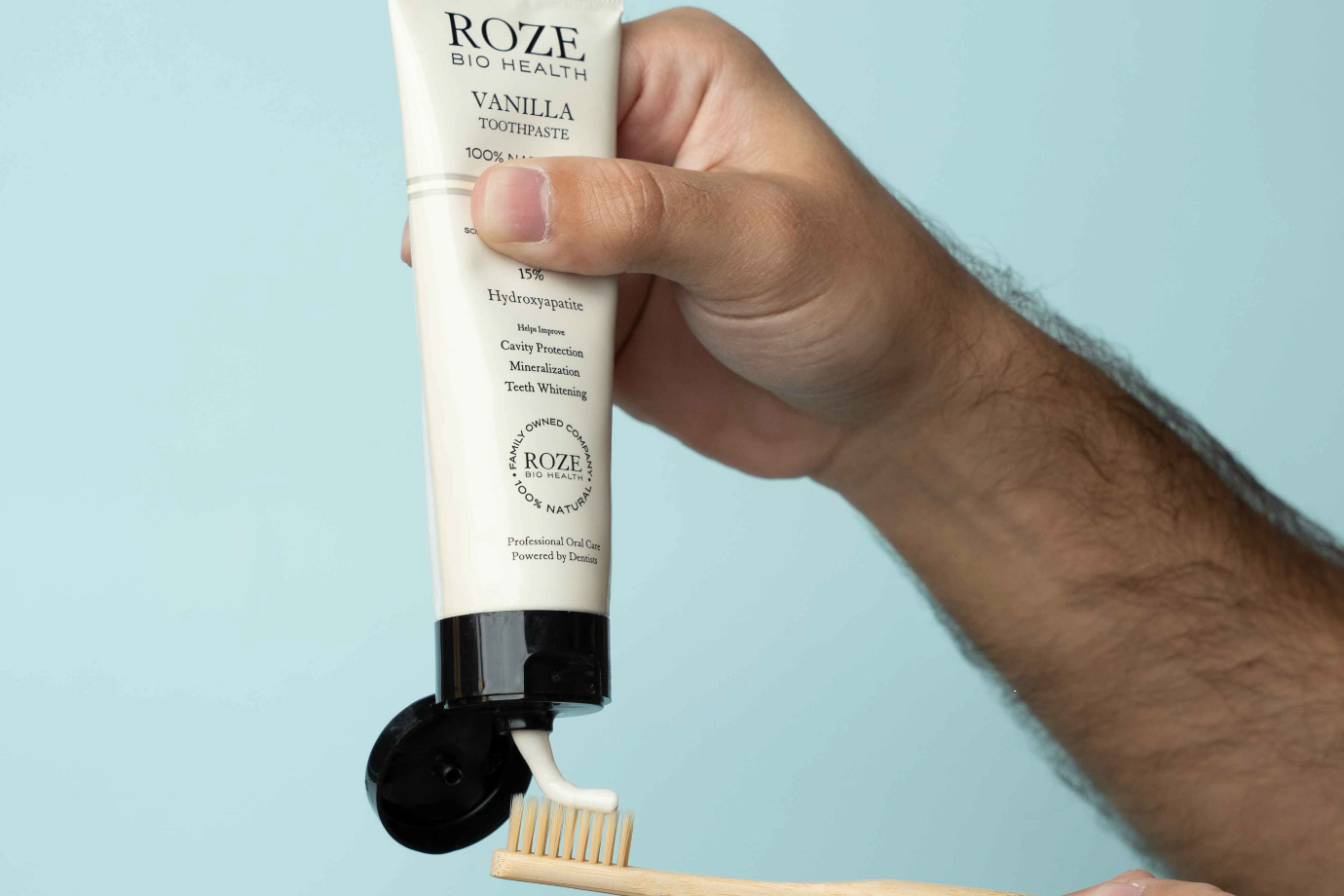
Walk down any supermarket aisle and you will find dozens of toothpaste options promising whitening, freshness, and cavity protection, often in nearly identical tubes with nearly identical ingredient lists. The real problem with most toothpastes is not that any single one is dangerous. It is that the category as a whole has been formulated for shelf stability, low cost, and broad appeal, rather than for the specific needs of the person actually using it.
Dr. David Roze noticed this gap from the other side of the chair. After more than 13 years practising biological dentistry in Dubai, he found himself repeatedly unable to recommend a single product on the shelf without a caveat, whether that meant a fluoride concentration he wasn’t comfortable with for a young patient, or a foaming agent that seemed unnecessarily harsh. That frustration is what eventually led him to formulate ROZE BioHealth: a toothpaste made in UAE, rather than imported and reformulated for an entirely different market.
Why most toothpaste looks the same, because mostly it is
Large toothpaste brands operate at enormous scale, and at that scale, formulas are optimised for cost, manufacturing simplicity, and a long shelf life across global supply chains. That is not inherently wrong, but it does mean certain ingredients become defaults less because they are the best available option and more because they are inexpensive and reliable to produce at volume.
Sodium lauryl sulfate is a useful example. It creates the foaming sensation many people associate with a clean brushing experience, yet that foam has little to do with how effectively a toothpaste cleans or protects teeth. Similarly, fluoride concentration and delivery vary widely between products, and the active mineral content in many natural or whitening toothpastes is often present in only token amounts.
What tends to go missing in a mass-market formula
A few patterns show up repeatedly when you read ingredient lists closely:
- Low or undisclosed active mineral content. A product can be labelled as remineralising while containing only a trace amount of the mineral responsible for that effect.
- Harsh foaming and preservative agents. Sodium lauryl sulfate, parabens, and synthetic sweeteners are common, not because they are the only options, but because they are familiar and inexpensive to produce at scale.
- Microplastics. Some products still use plastic microbeads for texture or mild abrasion, despite naturally derived alternatives being widely available.
- Limited transparency about manufacturing standards. Certifications, country of origin, and testing rigour are often left off the packaging entirely.
What this looks like for the people actually brushing
These gaps are not abstract. A parent choosing a toothpaste for a child who still swallows half of it wants to know the formula is genuinely food-grade, not just labelled gentle on the front of the tube. An adult who dreads the first sip of iced water wants an active ingredient that does measurable work on exposed dentine, not a token amount included for the claim on the box. Someone trying to cut down on synthetic additives across their whole household wants a short, honest ingredient list they can actually read in one go.
These are ordinary, recurring concerns, and they are exactly what a more deliberately formulated, UAE-made toothpaste was built to answer rather than another global brand simply repackaged for a new shelf.
A toothpaste made in UAE, built around what was missing
It was developed and manufactured in the UAE specifically to close these gaps, rather than to compete on price or shelf space. Being made by a UAE toothpaste brand also means shorter supply chains and formulation decisions made with the regional climate and a dentist’s own patient base in mind, rather than adapted from a formula designed for an entirely different market.
The table below sets out, in general and balanced terms, how a typical mass-market toothpaste tends to differ from this approach.
| Element | Typical mass-market toothpaste | ROZE’s UAE-made formula |
|---|---|---|
| Active mineral | Fluoride, often at varying or undisclosed strength | 15% micro-hydroxyapatite, clinically disclosed |
| Foaming agent | Frequently sodium lauryl sulfate | Sodium lauryl sulfate free, gentler alternative |
| Preservatives | Often includes parabens | Paraben-free |
| Texture agents | May include microplastics | Microplastic-free |
| Manufacturing standards | Varies by brand and market | Made in the UAE with EU, FSC, SGS, and Halal certifications available |
None of this means mass-market toothpaste is unsafe. Major brands meet regulatory safety standards in the markets where they are sold. The difference lies in formulation priorities: a smaller, dentist-led brand can afford to ask more demanding questions of every ingredient than a global brand optimising for shelf economics.
Why made in UAE is part of the story, not just a label
Manufacturing locally allows closer oversight of every batch, from sourcing the micro-hydroxyapatite to final quality testing, rather than relying on a long, multi-country supply chain. It also means the formula was developed with a regional clinical practice in mind, shaped by the day-to-day questions Dr. Roze fielded from patients across Dubai, rather than adapted secondhand from a product built for a different climate, water profile, or population.
For families specifically, this matters in practical terms too. A food-grade, alkaline, fluoride-free formula that is genuinely safe if swallowed offers reassurance for parents of young children, while remaining gentle enough for daily use across the whole household.
The practical upside of getting the formula right
A more deliberately built formula tends to show up in everyday, noticeable ways rather than only on a certificate. A meaningful concentration of an active mineral such as hydroxyapatite can support the remineralisation of enamel and may help ease the kind of sensitivity that makes people avoid cold drinks. An alkaline base treats the oral microbiome with more care than an aggressively foaming, stripping formula. And because the result is food-grade rather than merely fluoride-free, it tends to suit the whole household, from young children to adults who simply want fewer synthetic additives in their daily routine.
What to check before choosing your next toothpaste
- Is the active ingredient’s concentration disclosed, or just implied by a marketing word like remineralising?
- Does the formula avoid sodium lauryl sulfate, parabens, artificial sweeteners, and microplastics?
- Is the pH balance alkaline, supporting rather than disrupting the oral microbiome?
- Where is it made, and are there independent certifications backing up the manufacturing claims?
Is fluoride-free toothpaste as effective as fluoride toothpaste against cavities?
Hydroxyapatite-based, fluoride-free toothpaste can support remineralisation and contribute to cavity defence when used as part of a consistent oral hygiene routine. Effectiveness depends on formulation quality and on maintaining good brushing habits, not on the absence of fluoride alone.
Why do so many toothpastes contain sodium lauryl sulfate if it isn’t necessary for cleaning?
Sodium lauryl sulfate is inexpensive and produces the foaming texture many people associate with a thorough clean, even though foam itself is not a measure of cleaning effectiveness. Gentler alternatives can achieve a comparable brushing experience.
Is a toothpaste made in UAE held to the same standards as European or American brands?
Manufacturing standards depend on the individual facility and its certifications, not the country alone. Look for specific markers, such as EU compliance, SGS testing, or Halal certification, rather than assuming quality based on origin in either direction.
Is natural toothpaste automatically better than conventional toothpaste?
Not automatically. Natural is not a regulated term, so it is worth checking the actual ingredient list and disclosed concentrations rather than relying on the word alone.
The takeaway
The real problem with most toothpaste is not any single dangerous ingredient. It is a category built for cost and convenience at a global scale, where active ingredients are often present in token amounts and transparency is inconsistent. A dentist-formulated toothpaste made in UAE is not automatically superior simply for being different, but it does answer many of the specific questions a careful reader of ingredient labels tends to ask.
If you want to see what this looks like in practice, ROZE’s Dental Kit pairs the 15% hydroxyapatite toothpaste with a bamboo toothbrush, and offers a straightforward place to start.