

Most people know they should clean between their teeth. Far fewer do it every day, and many of those who try string floss give up within a week because it feels fiddly, makes their gums bleed, or simply takes too long at the end of a tiring evening. So the question of flossing vs water flossers is rarely academic. It usually comes from someone who wants a between-teeth habit they will actually keep.
This guide sets out how each method works, where each one shines, and who tends to do better with which. It draws on the everyday clinical experience behind ROZE, which was created by Dr. David Roze, a biological dentist with 13+ years of clinical practice in Dubai. In the surgery, the most common answer to “which is better?” is a slightly unglamorous one: the method you will use properly, every day.
Why cleaning between your teeth matters so much
A toothbrush, however good, reaches only three of the five surfaces of each tooth. The two surfaces that face neighbouring teeth stay largely untouched, and that is exactly where plaque settles undisturbed. Those tight contact points are among the most common places for decay to begin and for gum inflammation to take hold.
Plaque left between teeth for a day or two begins to irritate the gum margin. The gum responds with redness, a little swelling and bleeding when touched. Left alone for months, that early inflammation can progress, and some of the plaque hardens into tartar that only a dental professional can remove. Interdental cleaning is how you interrupt that cycle at home.
Both string floss and water flossers aim to do this job. They simply go about it in very different ways.
How string floss works
Traditional floss is a thin strand of nylon or PTFE that you slide between two teeth and then curve against each tooth surface in turn. The cleaning comes from friction: the floss physically scrapes the sticky film of plaque off the enamel and from just below the gumline.
When the technique is right, this is very effective. The weak point is that the technique is often wrong. Many people snap the floss straight down onto the gum, saw it back and forth, or pop it in and out without wrapping it around the tooth. That removes food debris but leaves much of the plaque film in place.
Where floss does well
- Tight contacts between healthy teeth, where its thin profile slips through easily.
- Mechanically disrupting established plaque, thanks to direct contact with the tooth.
- Portability and cost: a small reel fits in a pocket and needs no power or water.
Where floss struggles
- Braces, fixed retainers, bridges and implants, where threading the strand is slow and awkward.
- Reduced hand dexterity, arthritis, or simply large hands working in a small mouth.
- Consistency: it is the step people most often skip.
How water flossers work
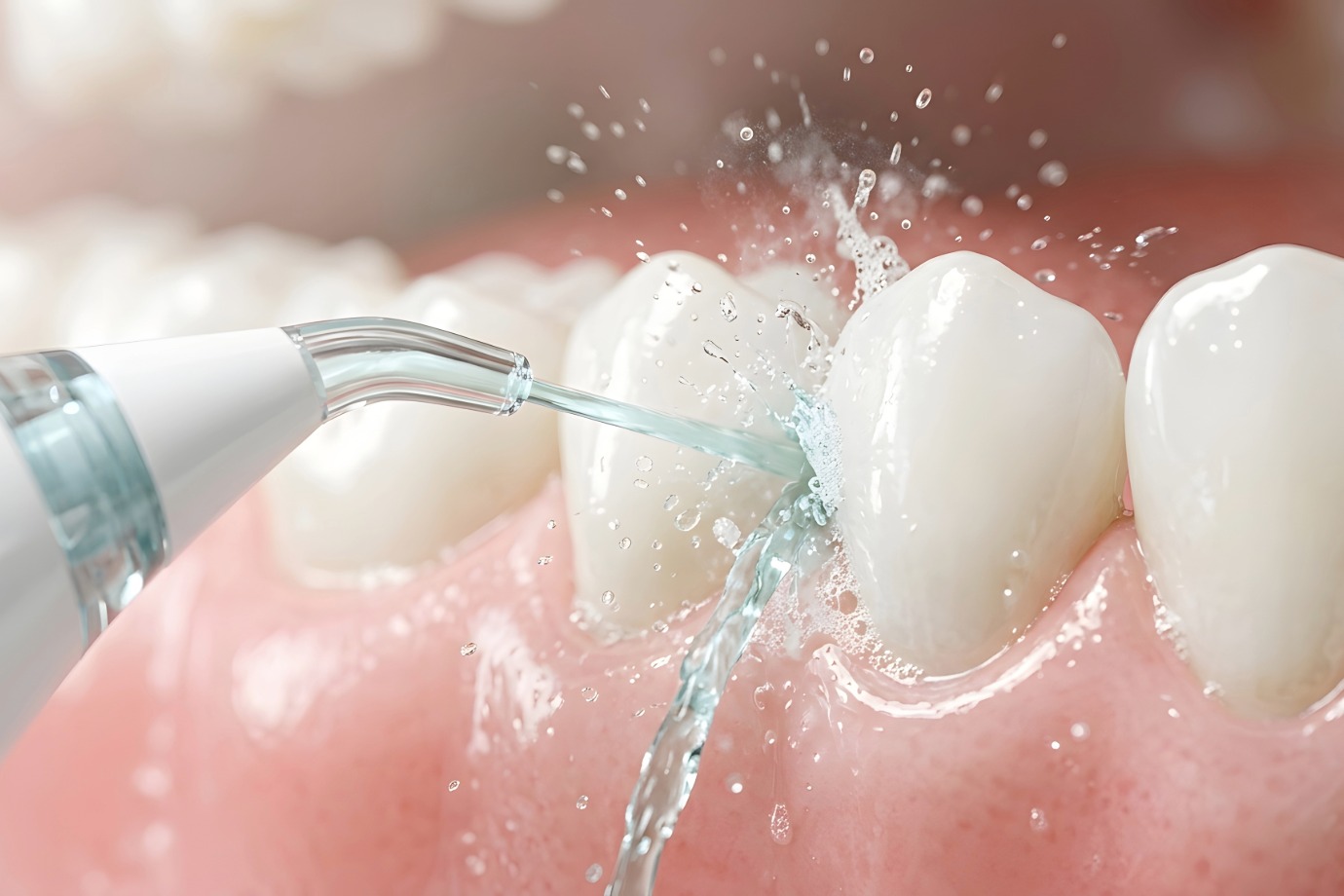
A water flosser, sometimes called an oral irrigator, sends a thin, pulsating stream of water through a small tip. You guide the tip along the gumline and pause briefly between each pair of teeth. The pulsing action flushes out food particles and disturbs the bacterial film around and just under the gum margin.
Because nothing has to be threaded through a contact point, water flossers are much easier for many people to use well. They are especially popular with anyone wearing orthodontic appliances, and many people with sensitive or easily bleeding gums find the sensation gentler than string.
Where water flossers do well
- Cleaning around brackets, wires, bridges, crowns and implants.
- Reaching slightly deeper along the gum margin without pressure from a string.
- Comfort and ease, which often translates into better daily habits.
Where water flossers fall short
- Very tight contacts, where a stream of water may not fully dislodge stubborn plaque.
- Cost, bench space and the need for a power source or charging.
- Travel, although cordless models have made this much easier.
Flossing vs water flossers at a glance
Neither tool wins on every measure. The table below summarises the practical differences most people weigh when deciding.
| Consideration | String floss | Water flosser |
|---|---|---|
| How it cleans | Direct friction against each tooth surface | Pulsating water flushes and disturbs plaque |
| Tight contacts | Generally very effective | Can leave some sticky plaque behind |
| Braces, bridges and implants | Possible, but slow and fiddly | Usually much easier |
| Learning curve | Technique matters a great deal | Easier to use well quickly |
| Comfort for tender gums | Can feel harsh at first | Often feels gentler |
| Cost and convenience | Inexpensive and pocket-sized | Higher upfront cost, needs space and power |
Which one suits you better?
Rather than looking for a universal winner, it helps to match the tool to your mouth and your routine.
You may prefer string floss if
- Your teeth are naturally close together and your gums are healthy.
- You are comfortable with the technique and already floss most days.
- You travel often and want something you can carry anywhere.
You may prefer a water flosser if
- You wear braces, aligner attachments, a fixed retainer, a bridge or implants.
- Your gums bleed easily and string floss feels uncomfortable.
- You have limited dexterity, or you have repeatedly tried to floss daily and stopped.
Many people do best with both
In practice, a combination often works well. Some people use string floss or small interdental brushes for the tightest contacts a few times a week, and a water flosser daily for a quick, thorough flush along the gumline. Interdental brushes deserve a mention here too: for larger gaps, many dentists consider them one of the most effective tools available. Your dentist or hygienist can tell you which sizes suit your mouth.
Getting the technique right
Whichever method you choose, a few small habits make a large difference.
For string floss
- Use about 40 centimetres, winding most of it around one finger and taking up the used length on the other.
- Ease the floss gently through the contact point; never snap it down onto the gum.
- Curve it into a C shape around one tooth, slide it just below the gumline, and move it up and down a few times. Then repeat on the neighbouring tooth.
- Use a fresh section of floss for each gap.
For a water flosser
- Start on the lowest pressure setting and increase gradually as your gums adjust.
- Lean over the basin, close your lips slightly around the tip to avoid splashing, and let the water drain out.
- Aim the tip at a right angle to the gumline, tracing along it and pausing for a second or two between each pair of teeth.
- Work in a set order, outside then inside, so no area is missed.
A little bleeding in the first week or two is common when gums are inflamed and are being cleaned properly for the first time. It usually settles as the gums become healthier. Bleeding that persists beyond a couple of weeks is worth showing to your dentist.
Where your toothpaste fits in
Interdental cleaning removes plaque; brushing afterwards with a good toothpaste helps protect the surfaces you have just cleared. Many people find it logical to clean between their teeth first and brush second, so the toothpaste can reach those freshly exposed surfaces.
This is also a sensible moment to look at what your toothpaste contains. A remineralising formula built around hydroxyapatite, the mineral that makes up most of natural enamel, is designed to support the very areas that interdental cleaning targets. Gentle, low-abrasion ingredients matter too, particularly if your gums are tender while you build a new habit. A natural toothpaste without SLS, such as the Natural Fresh Mint Toothpaste from ROZE, keeps the routine simple and avoids the harsh foaming agents that some people find irritating on sensitive gums.
A soft-bristled brush completes the picture. Hard bristles and heavy pressure can wear the gumline, undoing some of the good work you do between the teeth.
Frequently asked questions
Can a water flosser completely replace string floss?
For many people, especially those with braces, implants or bridges, a water flosser used well every day can be an excellent main tool. For very tight contacts, some dentists still recommend occasional string floss or interdental brushes. Ask your dentist which approach suits the spacing of your teeth.
Should I floss before or after brushing?
Either is better than skipping it, but many clinicians prefer cleaning between the teeth first. This loosens plaque and debris so that brushing can clear it away, and lets your toothpaste reach the surfaces you have just cleaned.
Why do my gums bleed when I start flossing?
Bleeding usually signals that the gums are already inflamed because plaque has been sitting there. With gentle, consistent cleaning, it often eases within one to two weeks. If it continues, or if your gums are painful or swollen, see your dentist.
Are water flossers suitable for children?
Many older children, particularly those with braces, use water flossers comfortably with adult supervision and a low pressure setting. For younger children, a parent flossing for them with floss picks is often simpler. A dentist can advise based on your child’s age and teeth.
How often should I clean between my teeth?
Once a day is the usual recommendation, and the evening is often the most valuable time, since it clears the day’s food and plaque before the long overnight period when saliva flow is lower.
The takeaway
The debate over flossing vs water flossers matters less than most people think. String floss is precise, inexpensive and effective in skilled hands. Water flossers are easier, gentler and excellent around dental work. The best choice is the one that fits your mouth, your dexterity and your evening, so that it becomes a quiet daily ritual rather than a chore you abandon.
Pair that habit with soft brushing and a thoughtfully formulated toothpaste, and see your dentist regularly for a professional clean. For those looking for a dentist-formulated, fluoride-free option to complete the routine, the Dental Kit, which pairs a ROZE toothpaste with a soft bamboo toothbrush, offers one considered place to start.