

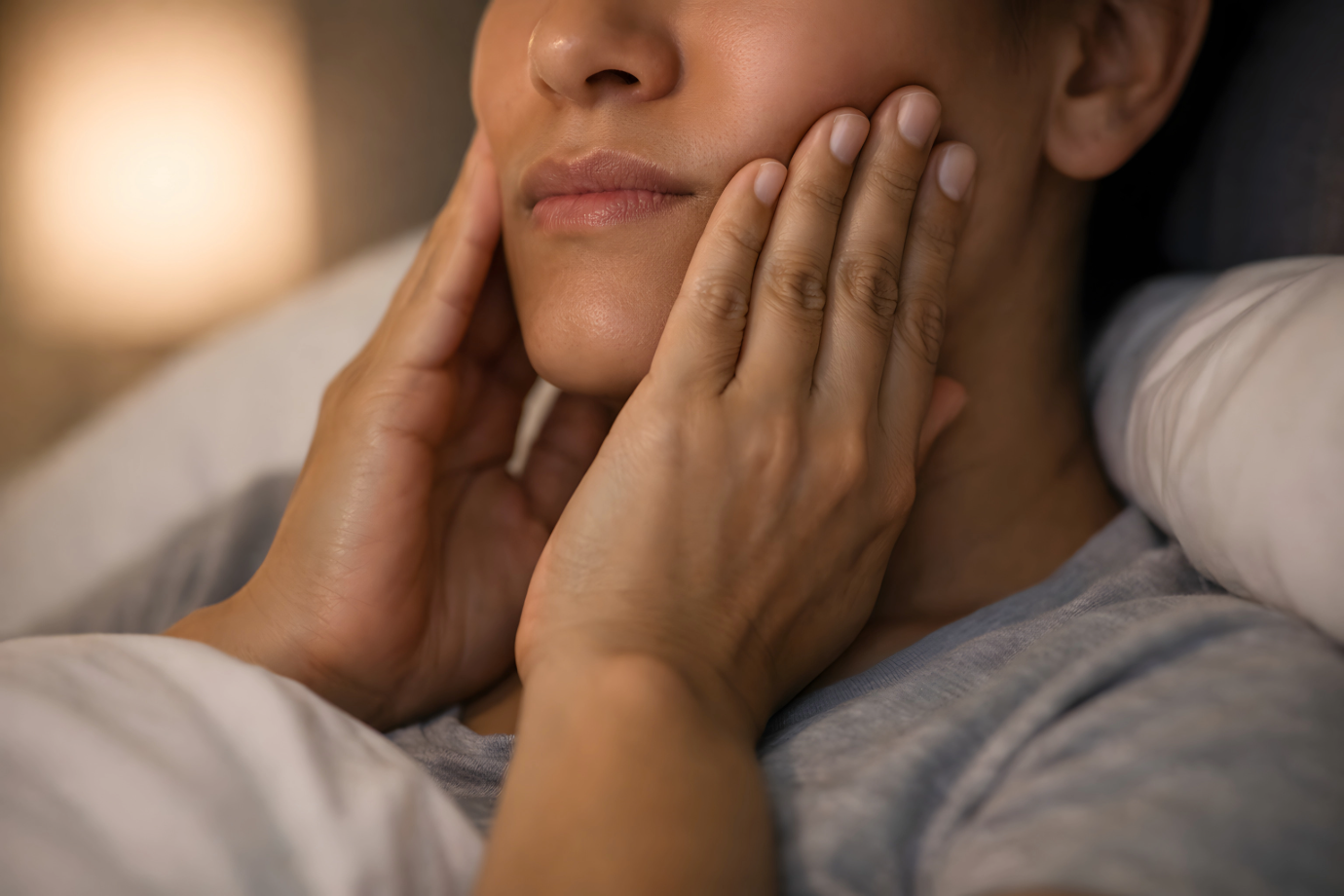
“How can I be grinding my teeth if I never notice it?” It is one of the most common questions dentists hear, and a fair one. Teeth grinding at night happens while you are asleep, so the person doing it is usually the last to know. The clues tend to arrive sideways: a partner who mentions a strange noise, a jaw that feels tired before breakfast, or a dentist who points out a chip or a flattened edge at a routine check-up.
Dr. David Roze, the biological dentist with 13+ years of clinical practice in Dubai who created ROZE BioHealth, sees the effects of night-time grinding regularly. Often the patient arrives worried about sensitivity or a dull headache and has no idea the two are connected. This article walks through the signs to look for, the reasons grinding happens, and the approaches that genuinely help protect your teeth and jaw.
What teeth grinding at night really is
The clinical name is bruxism. It covers clenching (pressing the teeth together hard) as well as grinding (moving them side to side under pressure). It can happen during the day too, but sleep bruxism is the type that tends to go unnoticed for longest.
During sleep, the jaw muscles can generate considerably more force than they ever do while you chew. Repeated night after night, that force places real strain on enamel, dental work, the jaw joints and the surrounding muscles. Occasional, mild grinding may cause no harm at all. Frequent or intense grinding is a different matter.
The signs to look for
Because you cannot catch yourself in the act, it helps to know the indirect signs. Run through this list honestly; two or three together are worth mentioning to your dentist.
In the morning
- A tired, tight or aching jaw on waking
- A dull headache, often felt at the temples
- Earache or a sense of fullness near the ears, with no ear infection
- Teeth that feel sore or slightly loose first thing
In your teeth
- Edges that look flatter, shorter or worn smooth
- Small chips, cracks or fine lines in the enamel
- New sensitivity to cold, sweet or hot foods
- Fillings, crowns or veneers that crack or come loose more often than expected
- Small notches near the gumline
In your mouth and face
- A scalloped edge along the sides of the tongue, where it presses against the teeth
- A white ridge along the inside of the cheeks
- Jaw muscles that feel firm or appear enlarged at the angle of the jaw
- Clicking or stiffness when opening the mouth wide
From someone else
A partner, parent or roommate who hears grinding or clicking at night is often the most reliable witness. If someone has mentioned it, take it seriously.
Why it happens
Sleep bruxism rarely has a single cause. It is usually the product of several overlapping factors.
Stress and anxiety. Busy, high-pressure periods are strongly associated with clenching and grinding, both by day and by night. Many people notice it flares during exams, work deadlines or life changes.
Sleep-related breathing problems. Snoring and obstructive sleep apnoea are linked with grinding in some people. If you snore loudly, wake unrefreshed or feel very sleepy during the day, a sleep assessment may be worth discussing with your doctor.
Stimulants and habits. Caffeine, alcohol and smoking, particularly in the evening, are associated with more grinding.
Certain medicines. Some medications, including certain antidepressants, can increase clenching. Never stop a prescribed medicine on your own, but do mention any connection you notice to your doctor.
Children. Grinding is common in young children and often fades as their teeth and jaws develop. It is still worth mentioning to a dentist, especially if a child complains of jaw pain or headaches.
What helps
There is no single switch that turns bruxism off. The goal is to protect the teeth from damage, reduce the triggers, and relieve the muscles. Most people do best with a combination of approaches.
A night guard
For persistent grinding, a night guard (also called an occlusal splint) is usually the first line of protection. It sits between the teeth while you sleep, absorbing the forces and preventing enamel from grinding against enamel. It does not necessarily stop the grinding itself, but it can spare your teeth a great deal of wear.
| Option | How it is made | Comfort and fit | Typical use |
|---|---|---|---|
| Custom-made guard from a dentist | Moulded precisely from impressions or a scan of your teeth | Slim, stable and usually the most comfortable for nightly wear | Ongoing or moderate to severe grinding |
| Boil-and-bite guard | Softened in hot water and shaped at home | Bulkier, can loosen or shift during sleep | Short-term stopgap while awaiting assessment |
| Stock guard | Pre-formed in standard sizes | Generally poor fit for night use | Rarely recommended for bruxism |
A poorly fitting guard can sometimes aggravate jaw discomfort, so a dentist-fitted option is generally the safer long-term choice.
Calming the jaw by day
Many people who grind at night also clench during the day without realising it. A simple habit helps: lips together, teeth apart, tongue resting gently on the roof of the mouth. Small reminders on your phone or computer can build the awareness until it becomes automatic.
Winding down before sleep
A calmer evening routine can reduce night-time tension. Gentle stretching, a warm shower, a short walk, reading rather than scrolling, and avoiding caffeine after midday and alcohol close to bedtime are all worth trying. Some people find a warm compress on the jaw muscles before bed soothing.
Professional support
Depending on the cause, your dentist may suggest physiotherapy for the jaw muscles, a referral for a sleep study, or other targeted treatment. Addressing an underlying sleep or breathing problem can sometimes reduce grinding considerably.
Looking after enamel that grinding has worn
Grinding wears away the outer enamel, and once enamel thins, the softer dentine beneath can become exposed. Dentine contains thousands of microscopic tubules that lead towards the nerve, which is why worn teeth often become sensitive.
A night guard protects against further wear, while your daily toothpaste can support the enamel you still have. A sensitive toothpaste based on hydroxyapatite works by depositing the same mineral that enamel is made from onto the tooth surface and into those open tubules. This can help remineralise weakened areas and reduce the sharp twinges that grinding often leaves behind, rather than simply numbing them. It is a supportive measure, not a repair for cracks or chips, which need a dentist.
Avoiding very abrasive whitening pastes matters here too, since worn teeth have less enamel to spare. ROZE was formulated by Dr. Roze with 15% micro-hydroxyapatite in a gentle, low-abrasion paste, and is made in the UAE. Paired with a soft brush, as in the Dental Kit, it suits teeth that have already been through a lot.
Frequently asked questions
Can teeth grinding at night damage my teeth permanently?
Yes, over time it can. Enamel does not grow back once it is ground away, and heavy grinding can chip teeth, crack fillings and contribute to jaw problems. Early protection with a night guard can limit further wear.
Will a night guard stop me grinding?
Not always. A night guard mainly protects the teeth and can reduce strain on the jaw. Reducing stress, improving sleep and addressing any breathing problems are what tend to reduce the grinding itself.
Is it normal for children to grind their teeth?
It is common, particularly in young children, and often fades with age. Mention it to your dentist so they can monitor wear and check for any related issues, such as disturbed sleep or breathing.
Why do my teeth feel more sensitive since I started grinding?
Grinding thins the enamel and can expose dentine, which reacts to temperature and sweetness. A hydroxyapatite toothpaste can help by remineralising the surface and sealing open tubules, but persistent sensitivity should still be checked by a dentist.
Can I use a fluoride-free toothpaste if my enamel is worn?
Yes. Hydroxyapatite is the very mineral worn enamel has lost, so a fluoride-free hydroxyapatite toothpaste rebuilds with like-for-like material rather than coating the surface with a synthetic additive. For worn teeth, that makes it a particularly sensible daily choice.
The takeaway
Teeth grinding at night is easy to miss and worth catching early. A tired jaw on waking, morning headaches, worn or chipped edges and new sensitivity are the signs that most often give it away. Once spotted, a dentist-fitted night guard, gentler evenings, daytime jaw awareness and attention to sleep can make a real difference to both comfort and the long-term health of your teeth.
The ROZE Clinical Team’s advice is to start with an examination, so the cause and the extent of any wear are clear. For those who would also like a gentle, dentist-formulated toothpaste to support worn enamel, the Natural Fresh Mint Toothpaste is one thoughtful place to start.