

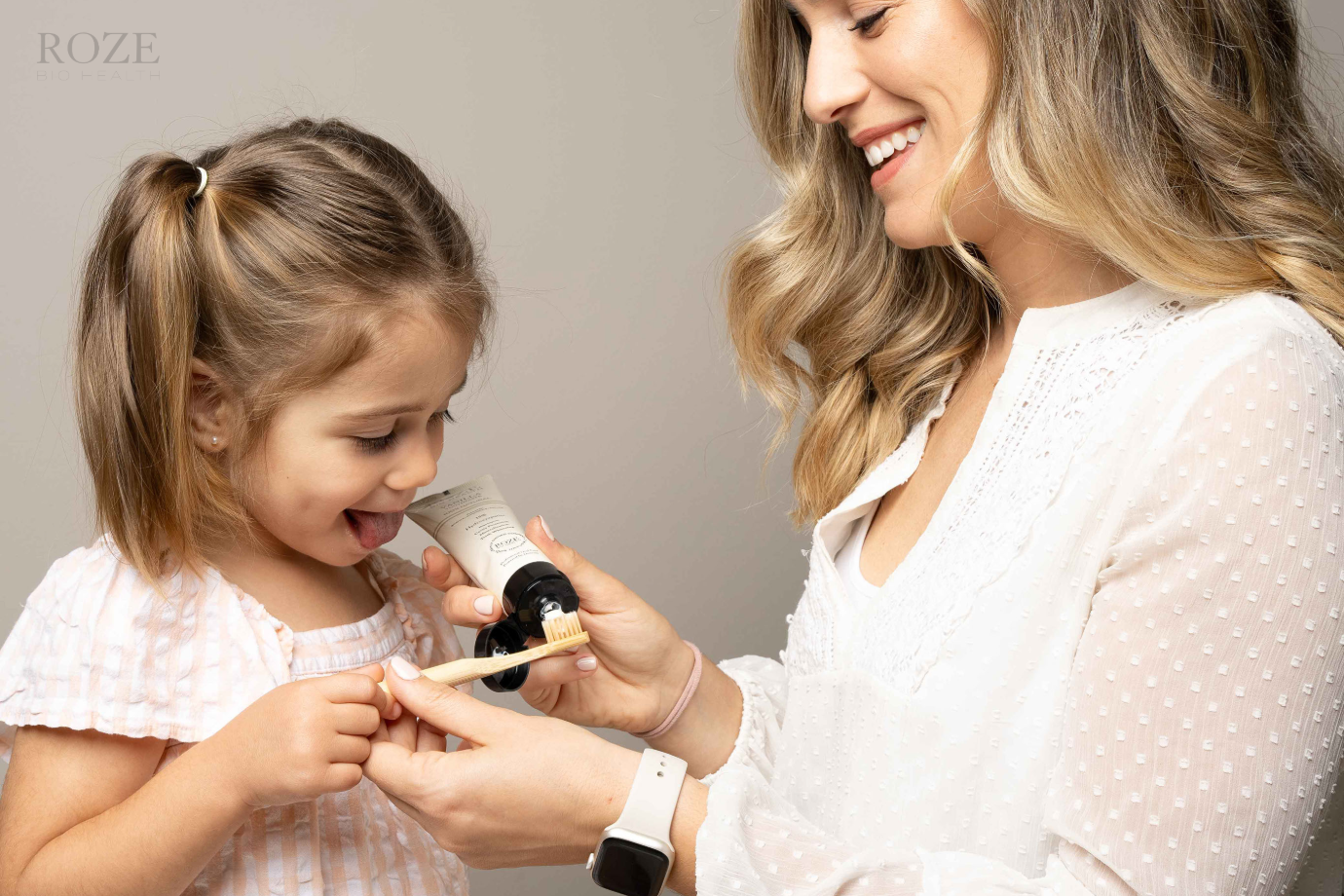
When Your Toddler Swallows a Mouthful of Toothpaste
Every parent has been there. You turn away for a second to grab a towel, and your toddler has already swallowed most of what was meant to go on their teeth. The instinct is to panic, then to wonder: is this actually a problem, or just a normal part of learning to brush? It is one of the most common questions parents ask about children’s oral care, and the honest answer depends largely on what is in the tube.
ROZE BioHealth was founded by Dr. David Roze, a biological dentist with more than 13 years of clinical practice in Dubai, who has spent much of his career thinking carefully about exactly this question, both as a clinician and as a parent. That dual perspective, treating patients while also brushing his own children’s teeth each morning, shapes how ROZE approaches ingredient safety.
Why Swallowing Toothpaste Worries Parents
Young children have not yet developed the reflex to reliably spit rather than swallow. Dentists typically recommend supervised brushing until around age six or seven for exactly this reason. The concern is not really about toothpaste in general. It is about what happens when a child regularly ingests small amounts of a particular ingredient over months and years of brushing, twice a day, for the rest of childhood.
Most conventional children’s toothpastes contain fluoride, added deliberately because of its established role in supporting cavity resistance. Major dental associations around the world continue to endorse fluoride as safe and effective when used correctly, and that endorsement deserves respect rather than dismissal. The nuance parents are really asking about is dosage: fluoride is safe within a recommended amount, but consistent overconsumption in early childhood, most often through swallowing toothpaste rather than diet, has been associated with mild dental fluorosis, a cosmetic change in enamel appearance. That is one reason paediatric guidance is so precise about the pea-sized amount recommended for young children.
A Fluoride-Free, Remineralising Alternative
This is where hydroxyapatite has become part of the conversation for parents who want a considered alternative rather than a rejection of dental science. Hydroxyapatite is the mineral that makes up the majority of natural tooth enamel. In Japan, hydroxyapatite toothpaste has been part of mainstream oral care for more than 40 years, and because the mineral is structurally similar to what enamel is already made of, it is generally regarded as safe if swallowed. That quality is precisely what makes it appealing as a toothpaste for kids who have not yet mastered spitting.
ROZE’s formulations use a 15 percent micro-hydroxyapatite concentration, among the highest found in a consumer toothpaste, alongside a food-grade, fluoride-free formula designed to be gentle enough for daily family use, including for young children.
Why Baby Teeth Need Special Consideration
It helps to understand why parents worry so much more about swallowing at this age than at any other. The enamel on primary teeth, the ones that erupt in the first few years, is noticeably thinner than the enamel on adult teeth that eventually replace them. Thinner enamel means baby teeth can move from healthy to decayed more quickly if bacteria and sugars are left in contact with them for long periods, which is exactly why the early years of brushing matter so much even though these teeth will not be permanent.
This is also the window in which a child’s relationship with brushing gets set for years to come. A toothpaste that stings, tastes unpleasant, or causes a child to associate brushing with an unwanted taste in the back of the throat can quietly undo years of good habit-building. Parents often find that a mild, naturally sweetened, fluoride-free formula makes the twice-daily routine easier to enforce without a daily negotiation, which in itself supports better long-term oral health regardless of which specific ingredient is doing the remineralising work.
Fluoride and Hydroxyapatite Toothpaste, Compared
| Factor | Fluoride toothpaste | Hydroxyapatite toothpaste |
|---|---|---|
| Remineralisation | Strengthens enamel by aiding mineral uptake | Helps rebuild enamel using a mineral structurally similar to natural enamel |
| Sensitivity support | Available in dedicated sensitive formulations | May help occlude exposed dentinal tubules linked to sensitivity |
| Safety if swallowed | Safe in recommended doses; excess ingestion in early childhood is a known concern | Generally regarded as safe if swallowed in normal brushing amounts |
| Enamel compatibility | Well studied and widely endorsed by dental bodies | Biomimetic, mirrors the mineral composition of enamel |
| Family suitability | Suitable for most ages with dosage guidance | Often chosen for young children and pregnant women wanting a fluoride-free option |
Neither option is inherently superior. Fluoride remains a well-studied, widely recommended standard. Hydroxyapatite is a credible, evidence-informed alternative for families who prefer a fluoride-free routine. The right choice depends on a child’s individual risk factors and a family’s own preferences, ideally discussed with a paediatric dentist.
Beyond Swallowing Safety: Everyday Benefits for Children’s Teeth
Setting the fluoride question aside, hydroxyapatite offers a few qualities that matter for young mouths specifically. Because it works to gently remineralise weak spots in enamel, it can help support cavity resistance in children whose brushing technique is still, understandably, a work in progress. Its alkaline pH is also gentle on a developing oral microbiome rather than stripping it, and formulas free from SLS, parabens and artificial sweeteners reduce the number of ingredients a young child’s system needs to process at all, swallowed or not.
There is also a practical, everyday factor: flavour and texture matter enormously to a reluctant brusher. A toothpaste for kids that tastes genuinely pleasant, without relying on artificial sweeteners, can be the difference between a two-minute battle and a habit a child actually looks forward to.
What to Look For in a Toothpaste for Kids
- A short, recognisable ingredient list, free from artificial colours and sweeteners
- No microplastics, parabens or SLS, which can be unnecessarily harsh on developing gums
- A texture and flavour children will actually tolerate day after day
- Clear guidance on the correct amount for your child’s age, regardless of formula
- Continued supervision until a child reliably spits rather than swallows
Families exploring a fluoride-free option formulated with children in mind often look at ROZE’s Watermelon Toothpaste, developed with a family-friendly flavour and the same 15 percent hydroxyapatite formula used across the range.
Frequently Asked Questions
Is fluoride-free toothpaste safe for children?
Yes, when formulated for daily use with age-appropriate, food-grade ingredients. Fluoride-free options built around hydroxyapatite are widely considered a gentle alternative, though any concerns about a specific child’s cavity risk are best discussed with their dentist.
Does hydroxyapatite actually rebuild enamel?
Hydroxyapatite can help support the remineralisation of weakened enamel because it shares the same basic mineral structure as natural tooth enamel. It is not a cure for existing decay, but it is widely used to support enamel health over time.
What happens if my child swallows hydroxyapatite toothpaste?
Because the mineral is similar to what is already found in the body, occasional swallowing in normal brushing amounts is generally not a cause for concern, though children should still be encouraged to spit as soon as they are able.
At what age can a fluoride-free toothpaste replace a fluoride one?
There is no single answer. Some families choose fluoride-free from the start; others switch later. This is a personal decision best made alongside a paediatric dentist who knows your child’s cavity risk and dental history.
The Takeaway for Parents
The question of whether kids’ toothpaste is safe to swallow does not have a single universal answer. Fluoride, used correctly, remains safe and effective, and dismissing it outright would not be honest. But for parents who want to remove the swallowing question almost entirely while still supporting their child’s enamel, a fluoride-free, hydroxyapatite-based toothpaste for kids is a considered, evidence-informed choice worth discussing at your next dental visit. For families exploring that option, ROZE’s range offers one place to start.