

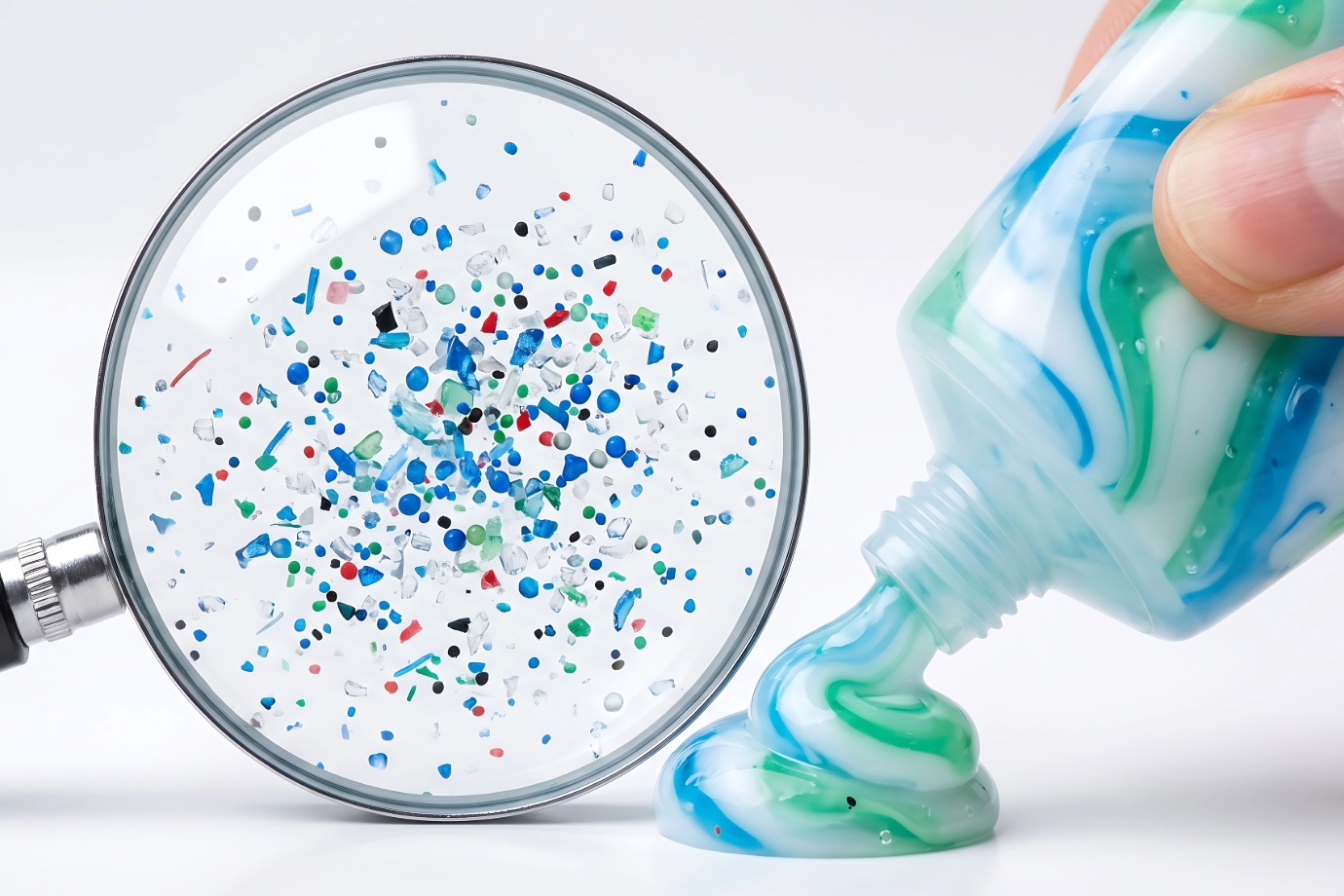
Few questions make a careful parent or a health-conscious adult pause like this one: what is actually in the tube, beyond what the label lists? Heavy metals such as lead, arsenic, cadmium and mercury are not ingredients anyone adds on purpose. They are trace contaminants that can travel with mineral raw materials, and a toothpaste is largely made of minerals. That is why independent heavy-metal testing of toothpaste is worth understanding, whatever brand you use.
This article explains why heavy metals are a legitimate concern for mineral-based oral care, how independent laboratory testing works, and how to read a test report with a sceptical eye. ROZE was created by Dr. David Roze, a biological dentist with 13+ years of clinical practice in Dubai, who wanted a toothpaste he could recommend to patients and use on his own children without hesitation.At the end, we share the results of our own independent SGS testing of all three ROZE flavours.
Why heavy metals are a question for toothpaste at all
Most toothpastes contain a mineral component. It may be an abrasive such as silica or calcium carbonate, a remineralising mineral such as hydroxyapatite, or a whitening agent. Minerals come from the earth or are synthesised from earth-derived materials, and the earth contains trace metals. Depending on where a raw material is sourced and how well it is purified, small amounts can remain in the finished product.
This is not unique to toothpaste. Spices, rice, cosmetics and mineral supplements all face the same issue, and responsible manufacturers in each category deal with it through sourcing and testing. What makes toothpaste a special case is simple: it is used twice a day, every day, for decades, and a trace of every brushing is swallowed, particularly by children.
For that reason, the standard worth asking of any toothpaste is not “does it contain heavy metals?” in a yes-or-no sense. Almost any mineral material can contain measurable traces. The better question is how much, how it was measured, and by whom.
What independent testing actually means
A manufacturer can test its own products, and many do so as part of routine quality control. That has value, but it is not independent. Independent testing means a separate, accredited laboratory with no commercial stake in the result analyses a sample and issues its own report.
A credible independent test usually has these features:
- The laboratory is accredited to a recognised testing standard, and its name is stated on the report.
- The sample is identified by product name and batch or lot number, so the result belongs to a real, specific production run.
- The method is named. Heavy metals in consumer products are commonly measured with instrumental techniques that detect very low concentrations, rather than simple colour tests.
- Each metal is listed separately, with a measured value and a stated detection limit.
- The report is dated and signed, and the full document is available rather than a one-line summary.
If a brand says only that its product is “tested” or “heavy-metal free”, without a laboratory, a batch or a method, the claim is hard to evaluate. Transparency is the real signal.
How to read a heavy-metals report
A laboratory report can look intimidating, but four details do most of the work. The table below sets out what each one tells you.
| Detail on the report | What it tells you | What to watch for |
|---|---|---|
| Laboratory and accreditation | Who measured the sample and whether the lab works to a recognised standard | No lab named, or a lab owned by the brand |
| Batch or lot number | That the result belongs to a specific production run | A generic report that is not tied to any batch |
| Detection limit | The smallest amount the method could reliably detect | “Not detected” with no limit stated, which means little |
| Individual metal values | Separate figures for each metal, such as lead, arsenic, cadmium and mercury | A single combined figure that hides the detail |
The detection limit deserves a moment of explanation. “Not detected” means the instrument found nothing at or above its limit of detection. If the limit is very low, that is reassuring. If the limit is high, the same words say much less. A good report lets you see the difference.
Why batch testing matters more than a single test
Raw materials vary between harvests, mines and suppliers. A single clean result from one year says little about a batch made eighteen months later. Brands that take the question seriously treat testing as a recurring habit, repeated across batches and whenever a supplier changes, not a one-time marketing exercise.
This is also why a reader is entitled to ask a brand whether results are available for the batch in their hand. A confident, transparent company will usually welcome the question.
Our own results: what SGS found
Explaining what to look for is only half the job, so we put our own toothpaste through the same scrutiny. We wanted to compare our flavours. More importantly, we wanted our patients, our customers and the dentists and practitioners who recommend ROZE to see exactly what is in the tube. The testing was carried out by SGS Gulf Limited in Dubai, part of one of the world’s largest independent testing groups. The full reports are linked below. For anyone who doesn’t want to read all 18 pages, here is a short summary.
What was tested
- All three flavours (Fresh Mint, Vanilla and Watermelon), each from a different production batch, made between July 2025 and July 2026
- 12 metals measured by ICP-MS: lead, mercury, arsenic, cadmium, antimony, nickel, chromium, barium, cobalt, copper, zinc and selenium
- Fluoride, measured by the accredited GSO 691/692 method
| Flavour | Batch number | Production date | SGS report numbers |
|---|---|---|---|
| Fresh Mint | BFZ26057 | 23 July 2026 | DXB26-0005759-003 and -006 |
| Vanilla | BFZ25077 | 24 October 2025 | DXB26-0005759-001 and -004 |
| Watermelon | BFZ25045 | 31 July 2025 | DXB26-0005759-002 and -005 |
Results
Every metal in every batch came back below the limit of quantification, which is the smallest amount the method can reliably measure. Each batch was tested in two ways:
- High-sensitivity testing. The limits were set very low: 5 parts per billion (ppb) for lead and mercury, and 10 ppb for the other ten metals. SGS ran this with its own in-house ICP-MS method, which sits outside its formal accreditation scope.
- Accredited testing. Lead, mercury, arsenic, cadmium and antimony were confirmed below 0.1 mg/kg (100 ppb) under SGS’s ISO/IEC 17025 accreditation (EIAC). Nickel, chromium, barium, cobalt and copper were confirmed below the same limit under IAS accreditation.
Fluoride was below 2 ppm in all three flavours.
(For reference, 1 mg/kg equals 1 part per million, ppm.)
How significant is this?
- Compared with another brand. An independent test of a US-based hydroxyapatite toothpaste reported lead at 0.32 ppm, arsenic at 0.21 ppm and mercury at 0.01 ppm. Those figures are within regulatory limits, but they are detectable. Our lead result is at least 60 times lower, and our arsenic at least 20 times lower.
- Compared with regulation. Regulatory limits for lead in cosmetics are in the low ppm range. Our results sit two to three orders of magnitude below them.
- Fluoride. A standard adult toothpaste contains 1,000 to 1,450 ppm fluoride, and the EU cosmetic maximum is 1,500 ppm. At under 2 ppm, ROZE is confirmed fluoride-free. That matters for young children, who tend to swallow toothpaste and for whom fluorosis is the main concern.
The hydroxyapatite angle: purity of the mineral matters
Hydroxyapatite is the mineral that makes up the great majority of tooth enamel, and it has been used in Japanese oral care for over 40 years. A hydroxyapatite toothpaste works by supplying that same mineral to the tooth surface, where it can help support remineralisation. Because the mineral is the active ingredient rather than a minor extra, its purity is central to the product.
Clinical-grade, food-grade hydroxyapatite is manufactured under controlled conditions, which is very different from simply grinding a natural rock. When you evaluate any hydroxyapatite toothpaste, the grade of the mineral and the evidence that it has been tested for contaminants are fair questions to ask. The same logic applies to natural toothpaste more broadly: a short, clean ingredient list is only as reassuring as the quality of each raw material in it.
What a parent can reasonably do
Most families do not have the time to audit supply chains, and they should not have to. A few practical habits go a long way:
- Choose brands that publish laboratory reports, or will send them when you ask.
- Check that results refer to a batch and name the laboratory.
- For young children, use a pea-sized amount for under-sixes (a smear for the youngest) and encourage spitting, which reduces what is swallowed regardless of the product.
- Prefer toothpaste with a short ingredient list you can read and understand, free from unnecessary colours, artificial sweeteners and foaming agents.
- Keep your dentist informed about what your family uses, particularly if anyone is pregnant or has a medical condition.
A note on ingredient literacy
Heavy metals are one entry on a longer label-reading list. Many people who look into this topic also start reading the rest of the ingredient panel: whether the formula contains sodium lauryl sulfate, artificial sweeteners, synthetic colours or microplastics, and whether it relies on fluoride. A growing number of people choose fluoride-free toothpaste because they would rather not swallow a synthetic additive with every brush when a food-grade mineral can support enamel instead. That is a choice about ingredient philosophy, and the heavy-metals question belongs to the same habit of asking what a product is made of and who has checked it.
Where ROZE fits
ROZE BioHealth formulates its toothpastes with 15% micro-hydroxyapatite, with no fluoride, SLS, parabens, artificial colours, artificial sweeteners or microplastics. The mineral at the centre of the formula is exactly why we think contaminant testing is a conversation brands should have openly. The full SGS reports for all three batches are published above. If you have a question about a specific batch, our team is glad to help, and we would encourage you to put the same question to any brand you consider.
Frequently asked questions
Do all toothpastes contain heavy metals?
Trace amounts of metals can occur naturally in mineral raw materials, so the useful question is how much is present and whether it has been measured by an accredited laboratory. Careful sourcing and batch testing are how responsible manufacturers manage this.
Is “heavy-metal free” a reliable claim?
On its own, not entirely. Any measurement depends on the detection limit of the method. A report that names the laboratory, the batch and the detection limit is far more informative than the phrase alone.
Is natural toothpaste automatically lower in heavy metals?
No. “Natural” describes the origin of ingredients, not their purity. Natural materials can carry traces from soil and water, so testing matters for natural toothpaste as much as for any other.
Is hydroxyapatite toothpaste safe if a small amount is swallowed?
Hydroxyapatite is the mineral your teeth and bones are already made of, and food-grade grades are used in oral care designed to be safe if a little is swallowed. As with any toothpaste, children should use only a small amount and be supervised, and your dentist can advise on your family’s needs.
How can I ask a brand for its test results?
Write to the brand and ask for the laboratory report for the current batch, including the laboratory name, method and detection limits. A transparent brand will typically share it.
The takeaway
Heavy-metal testing is not about fear. It is about the ordinary diligence we already expect of food and skincare, applied to a product we use every day. Look for named laboratories, batch numbers, stated detection limits and metal-by-metal figures, and be quietly sceptical of any claim that offers none of these.
For those exploring a fluoride-free option formulated by dentists, ROZE’s range offers one place to start. Whatever you choose, your dentist remains the best person to advise on your own oral health.