


Two tubes, both promising the same thing
Stand in front of two toothpaste boxes that both say “hydroxyapatite” on the front, and they can look nearly identical: similar language, similar clean packaging, similar promises about remineralising enamel. Read the fine print, if there is any, and the numbers tell a very different story. One tube might contain 15% hydroxyapatite. Another might contain a fraction of that, sometimes without stating a percentage at all. For an ingredient that works by physically rebuilding tooth structure, concentration is not a minor technical detail. It is close to the entire story, and it is the single most useful thing to check before deciding what the best hydroxyapatite toothpaste for your family actually is.
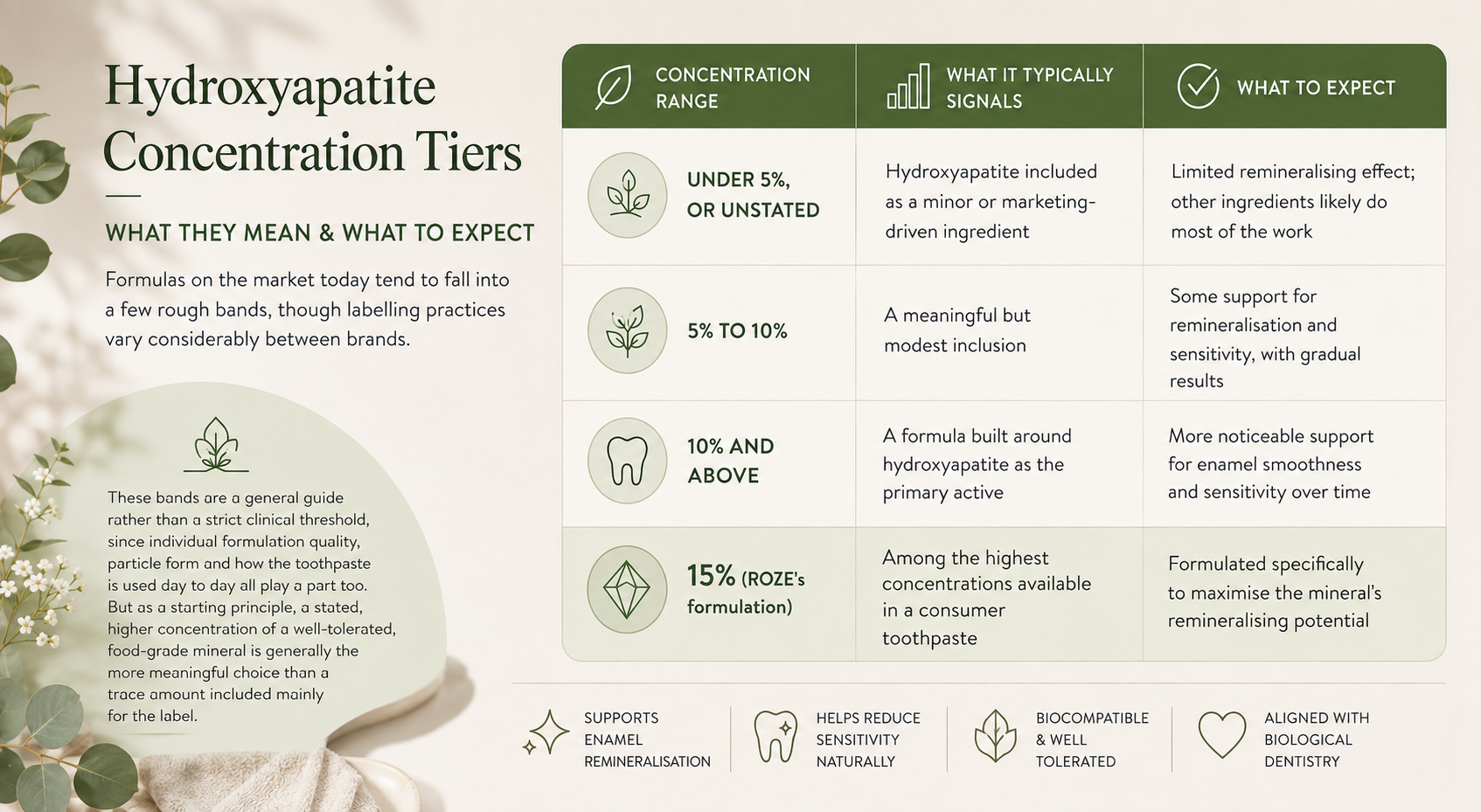
Dr. David Roze, a biological dentist who spent over thirteen years in clinical practice in Dubai before founding ROZE BioHealth, has spoken about this gap directly: a brand can print “hydroxyapatite” on a label at almost any concentration and still make the claim. His decision to formulate at 15%, among the highest concentrations used in a consumer toothpaste and the first at that level in the Middle East, was a deliberate response to just how much that number can vary between brands that all sound alike on the shelf.
Why the percentage on the label actually matters
Hydroxyapatite works by physically filling in the microscopic gaps and eroded areas on the tooth surface, a process that depends on there being enough material present to do meaningful work. A formula with a token amount of hydroxyapatite, included mainly so the ingredient can appear on the label, is unlikely to produce the same remineralising effect as a formula built around a clinically meaningful concentration. This is not unique to hydroxyapatite. It is true of most active ingredients in skincare, supplements and oral care alike: the presence of an ingredient and the amount of it are two separate questions, and only one of them determines whether you will actually notice a difference.
What the different concentration tiers generally look like
Why concentration alone does not make the best hydroxyapatite toothpaste
A high percentage does not automatically make a formula effective if the rest of the ingredient list works against it. Sodium lauryl sulfate, harsh abrasives or an unbalanced pH can all undercut what a well-dosed active ingredient is trying to do. It is worth treating concentration as a necessary condition rather than a sufficient one: a toothpaste needs enough hydroxyapatite to matter, and it also needs the rest of the formula to support rather than counteract it. The best hydroxyapatite toothpaste, in practical terms, is the one that gets both halves of that equation right at once, rather than leaning on a single headline number.
Micro-hydroxyapatite at higher concentrations
Particle form matters here too. ROZE’s formula uses micro-hydroxyapatite, the more established and thoroughly studied particle size, at its 15% concentration, rather than pairing a high number with the newer, less-reviewed nano form. A high concentration of a well-understood particle type is a more considered combination than either variable chosen in isolation.
A quick note on ingestion and concentration together
One question comes up naturally once concentration enters the conversation: is more hydroxyapatite something to worry about if a trace is swallowed during brushing, the way it might be with a synthetic additive. Because hydroxyapatite is food-grade and already the mineral the body’s own teeth and bones are built from, a higher concentration does not carry the same category of concern that a higher concentration of a synthetic ingredient would. This is part of what makes formulating at a genuinely high percentage a realistic option in the first place.
Why a stated percentage is worth insisting on
It is worth being a little demanding here, because the cost of not checking is not trivial. A shopper who assumes any product bearing the word “hydroxyapatite” will behave similarly is likely to end up disappointed with results, and may wrongly conclude that hydroxyapatite itself does not work, when the real issue was a formula never dosed to do meaningful work in the first place. Treating the percentage as a baseline question, in the same way a shopper might check the percentage of active vitamin C in a serum, keeps the comparison honest.
How to actually check what you are buying
- Look for a stated percentage on the packaging or product page, not just the word “hydroxyapatite” somewhere on the ingredient list.
- Check whether the formula specifies micro or nano-hydroxyapatite, alongside the percentage.
- Be cautious of products that lead with the ingredient name in large text but give no concentration anywhere, including on the brand’s own website.
- Remember that a higher number in isolation is not a guarantee. Read the rest of the ingredient list for what else is, or is not, included.
ROZE’s Natural Vanilla Toothpaste carries the same 15% micro-hydroxyapatite formulation as the brand’s original mint version, for readers who want the concentration without the traditional mint flavour. For a full household routine built around the same formula, the brand’s Dental Bundles extend it across the family.
Frequently asked questions
Why does hydroxyapatite concentration vary so much between brands?
There is no requirement to disclose a specific percentage on most oral care packaging, which means a brand can include a small, inexpensive amount of the ingredient primarily to support a marketing claim, without it being formulated at a level likely to produce a meaningful effect.
Is a higher percentage always better?
Generally, yes, within a well-formulated, food-grade product, since more of the active mineral means more material available to support remineralisation. It is not, however, the only factor. The rest of the formula and consistency of use both matter alongside it.
What is the difference between micro and nano-hydroxyapatite?
Micro-hydroxyapatite uses larger particles and has a longer track record of use and study, including in Japanese oral care. Nano-hydroxyapatite uses smaller particles that some regulatory bodies are still reviewing for long-term safety data, which is why many formulators, ROZE included, favour the micro form.
How can I find out the actual concentration in a toothpaste I already own?
Check the product packaging and the brand’s own website first. If neither states a percentage, it is reasonable to contact the brand directly and ask, since a formulator confident in its concentration will generally state it plainly.
The takeaway
The word “hydroxyapatite” on a toothpaste label tells you very little on its own. The concentration behind that word is what actually determines whether the formula can do meaningful remineralising work. A stated, clinically meaningful percentage, paired with a well-tolerated particle form and a clean supporting formula, is a far more useful standard to shop by than the ingredient name alone. For readers who want to see what a formula built around that standard actually looks like, ROZE’s 15% micro-hydroxyapatite range offers a transparent place to compare against.