

Why flavour matters more than most people assume
Ask any parent who has tried to brush a toddler’s teeth against their will, and they will tell you that flavour is not a minor detail. It is often the difference between a two-minute routine done twice a day without complaint, and a nightly negotiation that ends with half a brush and a lot of frustration. Flavour decides whether toothpaste actually gets used consistently, and consistency is what makes any toothpaste effective in the first place.
Dr. David Roze, a biological dentist who has practised in Dubai for more than thirteen years, has watched this pattern play out in his clinic for a long time. Parents would ask for a fluoride-free option their children would tolerate, and adults with sensitive teeth would ask for something gentler than the intense mint they grew up with. That everyday feedback, as much as the clinical formula itself, shaped how ROZE BioHealth approached flavour when Dr. Roze and Dr. Agnes Roze developed their range.
What conventional flavouring usually relies on
Most mainstream toothpaste achieves its taste and sensation through a combination of artificial sweeteners, synthetic flavour compounds, and foaming agents such as sodium lauryl sulphate. The intense, almost fizzy mint sensation many people associate with “clean” teeth is largely a sensory effect created by strong foaming, not a sign of superior cleaning. In fact, some foaming agents are understood to temporarily suppress the tongue’s sweet taste receptors, which is one reason toothpaste can make orange juice taste strange straight afterwards.
None of this makes conventional toothpaste unsafe. It simply means the flavour experience is engineered around foam and intensity rather than around what a natural ingredient actually tastes like. ROZE took a different starting point: choose flavours that work well without needing that artificial intensity to feel effective.
Mint, without the harshness
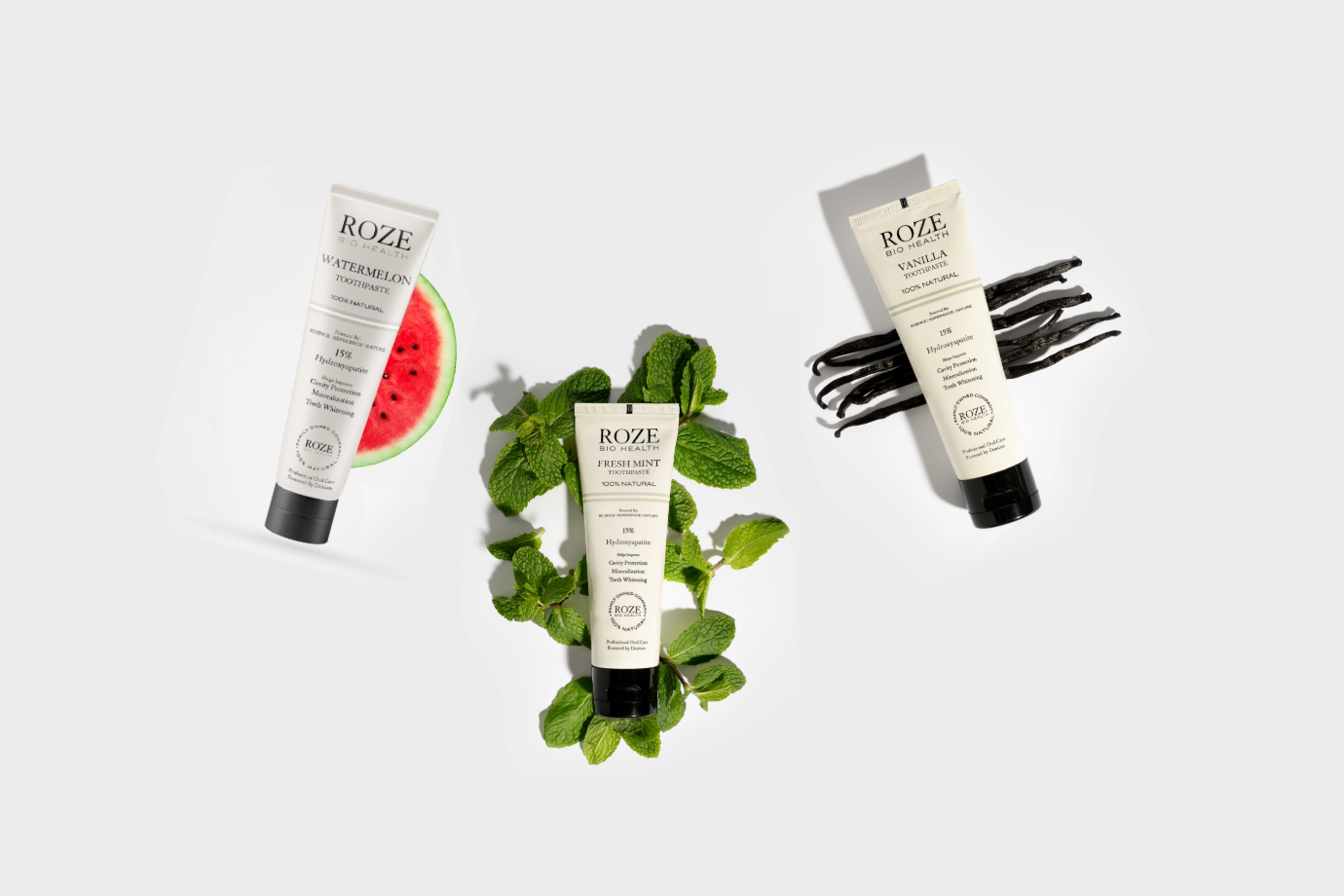
The Natural Fresh Mint Toothpaste remains ROZE’s bestseller, and it was formulated to give a genuinely fresh, clean sensation from real mint rather than an overpowering menthol burn. Because the formula is free from sodium lauryl sulphate, the mint flavour tends to come through more clearly rather than being masked by heavy foam, which many long-term users describe as a cleaner, less aggressive experience.
Vanilla, for a gentler ritual
The Natural Vanilla Toothpaste was created largely in response to patients who found mint a little too strong, particularly those managing sensitivity or simply preferring a softer, warmer taste for their evening routine. Vanilla is not a common toothpaste flavour, which is precisely the point: it offers an alternative for people who had come to associate brushing with a slightly unpleasant intensity rather than a calm, considered ritual.
Watermelon, made for smaller mouths
The newest addition, Watermelon Toothpaste, was designed with children and family routines specifically in mind. Its natural sweetness comes without added sugar, artificial dyes, or the sharp mint flavour many young children instinctively resist. The goal was straightforward: give parents a toothpaste their children will genuinely want to use, without compromising on what is actually in the tube.
A fair comparison: conventional flavouring versus a naturally flavoured formula
| Consideration | Conventional flavoured toothpaste | Naturally flavoured formula (ROZE) |
|---|---|---|
| Sweetening approach | Often relies on artificial sweeteners such as saccharin | Uses natural flavouring without artificial sweeteners |
| Colouring | May include artificial colours for visual appeal | Free from artificial colours |
| Foaming sensation | Often intensified with sodium lauryl sulphate | SLS-free, gentler foaming |
| Sensory intensity | Can feel sharp or overpowering, especially for children | Designed to feel milder while remaining pleasant |
| Family suitability | Varies widely by product | Formulated with all ages, including children, in mind |
Neither approach is inherently wrong, and plenty of conventional toothpaste is perfectly safe for daily use. The distinction is simply about what is doing the work of making the toothpaste taste pleasant, and whether that ingredient list is one you would feel comfortable reading aloud to your family.
The same foundation, whichever flavour you choose
Whichever of the three flavours a household settles on, the underlying formula does not change. Each contains 15% micro-hydroxyapatite, the mineral that makes up the majority of natural tooth enamel, alongside an alkaline pH designed to work with the mouth’s natural chemistry rather than against it. None contain fluoride, parabens, or microplastics. Flavour, in other words, is the one variable that can be adjusted to suit personal taste or a child’s preference, without touching the clinical substance of the toothpaste itself.
Benefits that hold steady across all three
- Support for enamel remineralisation regardless of the flavour chosen
- A gentle, alkaline formula that may help support a balanced oral microbiome
- No rinse required, which suits children who are still learning proper brushing habits
- Suitable for adults, children, and, with a dentist’s guidance, during pregnancy
How to choose a flavour for your household
There is no single correct answer here, and the best flavour is simply the one that gets used consistently, morning and evening, without a fight. A few practical points can help.
- For children who resist brushing, a milder, naturally sweet flavour such as watermelon often lowers the daily friction considerably
- For adults managing sensitivity, a gentler flavour like vanilla can make the routine feel less like a chore
- For those who simply want a classic, familiar taste, mint without the harsh, foaming intensity is often the easiest transition from a conventional toothpaste
- Families with mixed preferences can simply keep more than one flavour in rotation, since the underlying formula is identical across all three
Frequently asked questions
Is watermelon toothpaste safe for young children?
Yes. It was formulated without fluoride, artificial sweeteners, or added sugar, and is generally considered safe to swallow typical of young children still learning to spit rather than swallow. As with any new product, parents with specific concerns should check with their dentist.
Does flavour affect how well a toothpaste actually works?
Flavour itself does not change the core mineral formula, but it strongly influences whether a toothpaste gets used consistently. A toothpaste used reluctantly or inconsistently is far less effective than one a person or child is happy to use twice a day.
Can adults use the watermelon flavour, or is it only for children?
Many adults enjoy it. There is no formulation difference that restricts it to children, it was simply designed with a milder, family-friendly taste profile in mind.
Is vanilla toothpaste less effective than mint against plaque or cavities?
No. All three flavours share the same 15% hydroxyapatite base and the same free-from ingredient list. The difference is entirely in taste and sensory experience, not in the underlying formula.
Why does natural mint toothpaste feel less foamy than conventional brands?
Because it is free from sodium lauryl sulphate, the ingredient primarily responsible for the thick foam in many conventional toothpastes. Less foam does not mean less cleaning, it simply reflects a different, gentler formulation choice.
Can flavour preference change over time?
It often does. Children who start on watermelon sometimes move to mint as they grow older and their palate changes, while adults who switch away from a heavily foaming conventional toothpaste occasionally find they prefer a milder flavour than the one they grew up with. There is no need to settle on one flavour permanently, and rotating between tubes in a household is entirely normal.
A word on the wider free-from list
Flavour tends to be the most immediately noticeable difference between toothpastes, but it sits alongside a longer list of choices about what has been deliberately left out of the formula. Beyond the absence of artificial sweeteners and colours already discussed, ROZE’s toothpaste is also free from sodium lauryl sulphate, parabens, fluoride, and microplastics, each replaced with a more natural alternative where one exists. None of these choices were made lightly, and each reflects the same underlying question Dr. Roze has asked throughout his career: would he be comfortable using this on his own children, every single day, without reservation.
Taken together, flavour and formula end up reinforcing each other. A toothpaste that tastes pleasant without artificial intensity is also, in ROZE’s case, one built on a shorter and more transparent ingredient list, which is worth knowing whether or not flavour was the reason you first considered switching.
The takeaway
Flavour is often treated as an afterthought in oral care, when in practice it shapes whether good habits actually stick. Choosing a toothpaste that tastes good without leaning on artificial sweeteners, dyes, or harsh foaming agents is a small decision with a genuinely daily impact. For families exploring a natural toothpaste that lets everyone find their own favourite, ROZE’s range of mint, vanilla, and watermelon offers a considered place to start.