


The label most of us never actually read
Most parents check the ingredient list on baby food, sunscreen, and even shampoo without a second thought. Toothpaste, oddly, tends to escape the same scrutiny, even though it goes into a child’s mouth twice a day, every day, for years. Once you start reading past the flavour and the marketing claims on the front of the tube, three ingredients tend to come up again and again: sodium lauryl sulphate, parabens, and fluoride.
Dr. David Roze, a biological dentist with more than thirteen years of clinical practice in Dubai, spends a good part of his consultations doing exactly this with concerned parents: turning the tube around and reading the small print together. That habit, more than any single product, is what led him and Dr. Agnes Roze to formulate ROZE BioHealth’s toothpaste around a shorter, more transparent ingredient list.
Sodium lauryl sulphate (SLS): the foaming agent
SLS is a surfactant, the ingredient responsible for the thick foam most people associate with a “proper” clean. It is inexpensive, effective at creating lather, and used across a huge range of household and personal care products. In the mouth, however, SLS can be drying and irritating for some people, and it has a recognised association with triggering or worsening mouth ulcers in those already prone to them. For a child with a sensitive mouth, an SLS-heavy toothpaste can occasionally make brushing an uncomfortable experience rather than a pleasant one.
It is worth being clear here: foam itself does not clean teeth, mechanical brushing does. A toothpaste can be entirely effective without producing the dramatic lather many of us grew up expecting.
Parabens: the preservative question
Parabens are a family of preservatives used to extend shelf life and prevent bacterial or fungal growth in cosmetic and personal care products, including many toothpastes. Regulatory bodies in most regions permit their use at controlled concentrations. That said, a growing number of parents prefer to avoid them where possible, largely due to ongoing research interest into how certain parabens interact with hormone receptors at higher exposure levels. The evidence here is still developing rather than settled, which is exactly why many families choose caution as a reasonable, personal decision rather than a response to proven harm.
Formulating a paraben-free toothpaste that still has an acceptable shelf life is genuinely harder, which is part of why paraben-free options can be less common on crowded supermarket shelves than the marketing on many “clean” labels might suggest.
Fluoride: what the emerging science is starting to question
Fluoride has a long history in cavity prevention and remains recommended by many dental associations, but the conversation around it is shifting and parents are right to pay attention. What is increasingly difficult to ignore is the body of research linking fluoride to neurotoxic effects at cumulative exposure levels, including a 2020 meta-analysis published in Environmental Health Perspectives and a landmark 2024 systematic review commissioned by the US National Toxicology Program, which concluded that fluoride is “likely to be associated with lower IQ in children” at levels found in many public water supplies.
The critical issue is not a single brushing session but cumulative load. Children in fluoridated water regions are already ingesting fluoride through drinking water, food, and beverages. Adding a fluoride toothpaste to that daily exposure, particularly at an age when swallowing during brushing is common, adds meaningfully to that cumulative burden. The body does not excrete fluoride efficiently and it accumulates in bone and soft tissue over time.
This is not a fringe concern. Canada’s national health authority recently lowered its recommended fluoride level in drinking water, and Denmark, the Netherlands, and several other European countries have never fluoridated their water supplies, citing precautionary concerns. The direction of travel in the science is increasingly cautious.
Hydroxyapatite offers a compelling alternative precisely because it sidesteps these concerns entirely. It is a naturally occurring mineral, the same one that makes up 97% of tooth enamel, and the clinical evidence for its efficacy in remineralisation and cavity prevention is robust and growing. It carries no cumulative toxicity risk, no dosage guidance to manage, and no neurodevelopmental question marks. For parents who have weighed the evidence and want to reduce their family’s total fluoride load without compromising on dental protection, hydroxyapatite is not simply a fluoride-free option. It is a genuinely better-evidenced choice for daily home use.
A side-by-side look
| Ingredient | What it does | Why some parents look for alternatives |
|---|---|---|
| Sodium lauryl sulphate (SLS) | Creates foam and lather during brushing | Can dry or irritate sensitive mouths and may aggravate mouth ulcers |
| Parabens | Preserves the product and extends shelf life | Ongoing research interest into hormone interaction at higher exposure levels |
| Fluoride | Supports remineralisation and cavity prevention | Requires careful dosing in young children who may swallow toothpaste |
Reading a label this way is not about fear, it is about making an informed choice that fits your family’s preferences and your dentist’s advice.
What a shorter ingredient list can look like
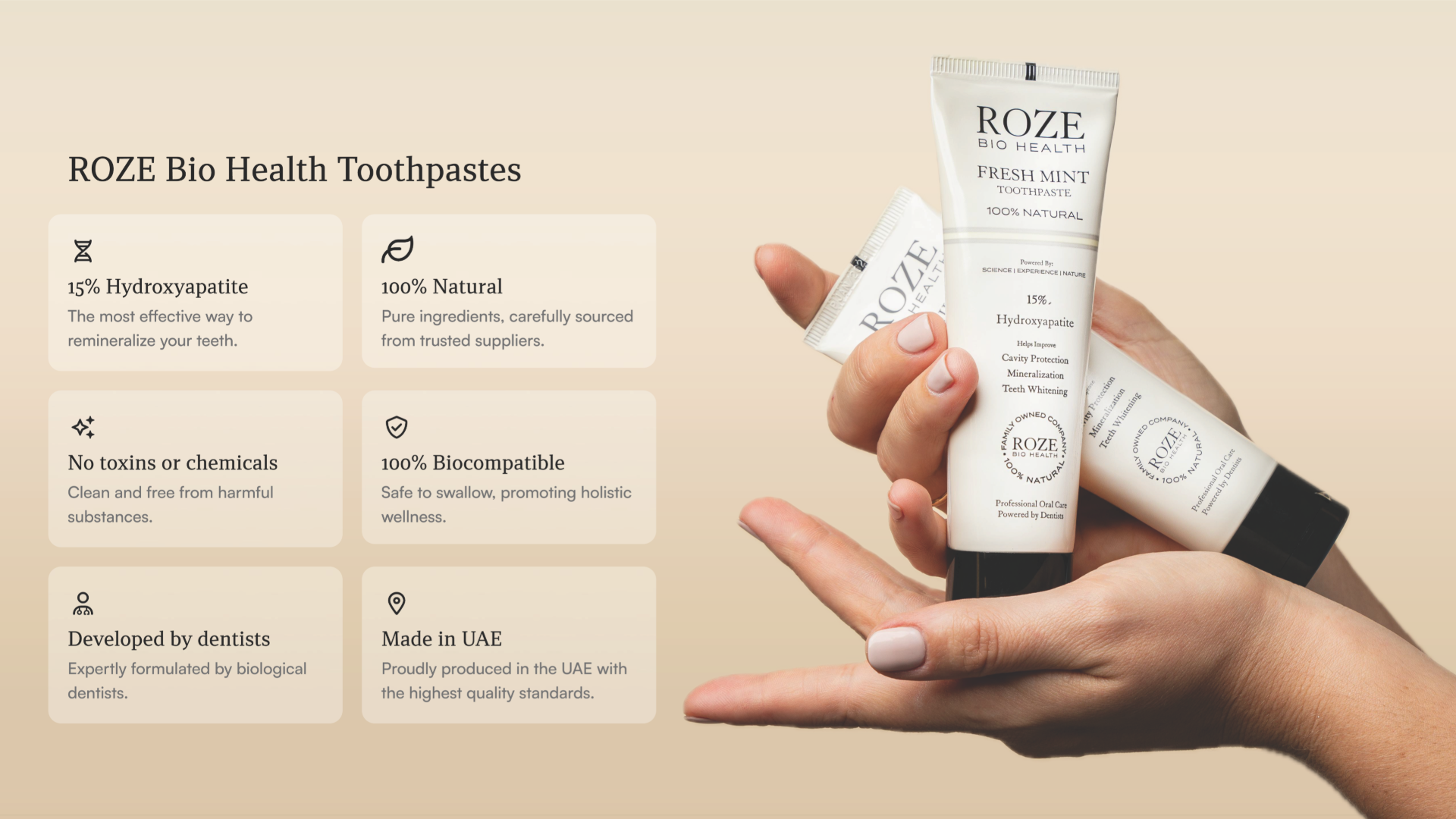
ROZE BioHealth’s toothpaste range, including the Natural Fresh Mint Toothpaste, was formulated without SLS, parabens, fluoride, artificial colours, artificial sweeteners, or microplastics. In their place is 15% micro-hydroxyapatite, the mineral that already makes up the majority of natural tooth enamel, in an alkaline base designed to work with the mouth’s natural chemistry rather than strip it.
What to check for on any toothpaste label
- Whether SLS or a similar sulphate surfactant appears near the top of the ingredient list
- Whether parabens are listed, often under names ending in “-paraben”
- The fluoride concentration, and whether it is appropriate for your child’s age
- Whether artificial colours or sweeteners are present, particularly in children’s formulas
- Whether the brand discloses its full ingredient list clearly, rather than only listing “active ingredients”
Making the switch without overcomplicating it
You do not need to overhaul your family’s entire bathroom cabinet overnight. Many parents start by switching the toothpaste used by the most sensitive member of the household, whether that is a child prone to ulcers or an adult managing enamel sensitivity, and expand from there once they see how it suits their routine. Bringing your child’s toothpaste to your next dental check-up is also a simple, useful habit, since a dentist who knows your child’s history can advise on whether the formula suits their specific needs.
Why a shorter list is often harder to make, not easier
It is worth acknowledging that removing SLS, parabens, and fluoride from a toothpaste does not automatically make it better, it simply changes what the formulator has to solve for instead. Without SLS, achieving a texture and mild foam that still feels satisfying during brushing requires a different approach to the base formula. Without parabens, preserving the product safely over its shelf life takes more careful selection of alternative stabilisers. Without fluoride, the active ingredient responsible for remineralisation has to be replaced with something that genuinely performs that role rather than merely appearing on the label. This is one reason a well-formulated free-from toothpaste can sit at a slightly higher price point than a mass-market equivalent, the shorter ingredient list often reflects more development work, not less.
Frequently asked questions
Is fluoride-free toothpaste effective against cavities?
Many fluoride-free formulas, particularly those built around a meaningful concentration of hydroxyapatite, are widely used to support enamel strength and cavity resistance. Individual risk factors vary, so a dentist is best placed to advise on what suits a specific child or adult.
Is SLS-free toothpaste less effective at cleaning?
No. Cleaning happens through the mechanical action of brushing, not through foam. An SLS-free toothpaste can clean just as thoroughly, often with less irritation for sensitive mouths.
Should I worry if my child swallows a small amount of toothpaste?
Swallowing a pea-sized amount occasionally is generally not a significant concern with most toothpastes formulated for children, though this is worth discussing with your dentist, particularly with fluoride-containing formulas where dosage matters more.
Are parabens actually dangerous?
Regulatory bodies generally consider parabens safe at the concentrations used in cosmetics and personal care products. The research into their effects at higher exposure levels is still developing, which is why some families choose to avoid them as a precaution rather than in response to established harm.
How do I know if a toothpaste is genuinely natural, rather than just marketed that way?
Read past the front of the packaging and check the actual ingredient list. A genuinely natural, free-from formula should be able to name exactly what it excludes, such as SLS, parabens, fluoride, artificial colours, and microplastics, rather than relying on vague terms like “natural origin” alone.
The takeaway
Reading a toothpaste label is a small habit that gives you real information, not a reason for alarm. SLS, parabens, and fluoride are each well understood ingredients with legitimate uses, and the right choice depends on your family’s preferences and your dentist’s guidance rather than a single right answer. For parents who would rather start from a shorter, more transparent list, ROZE’s range offers a dentist-formulated option worth a look.