

Fluoride-free toothpaste has moved from niche health-store shelf to a mainstream choice for a growing number of families, and with that shift has come a familiar wave of confusion. Some of it is outdated information. Some of it is simply guesswork repeated often enough that it starts to sound like fact. Below are five of the most common myths, along with what a closer look at the science actually shows.
ROZE BioHealth was founded by Dr. David Roze, a biological dentist with 13+ years of clinical practice in Dubai, alongside Dr. Agnes Roze, specifically to give patients a fluoride-free option he could recommend with full confidence, including to his own children. That clinical starting point is a useful lens for separating the myths from the reality.
Myth 1: fluoride-free toothpaste cannot fight cavities
This is the most persistent myth, and it rests on an outdated assumption that fluoride is the only ingredient capable of protecting teeth. Hydroxyapatite, the mineral that already makes up around 97% of natural tooth enamel, works differently but toward a similar goal. Rather than forming a surface coating, it can help remineralise weakened enamel from within, supporting the tooth’s own structure rather than sitting on top of it. Used consistently as part of a full routine, brushing twice daily, alongside flossing and regular dental visits, a well-formulated hydroxyapatite toothpaste can support cavity prevention effectively for most people.
Myth 2: hydroxyapatite is a new, unproven ingredient
It can feel new to a Western audience discovering it for the first time, but hydroxyapatite has been used in Japanese oral care for more than forty years, originally developed from research into astronaut bone density before making its way into toothpaste. Four decades of everyday use in a major market is a meaningfully long track record, even without pointing to any single study. The ingredient is not experimental. It is simply newer to markets outside Asia, including the Middle East, where ROZE was the first to bring a 15% hydroxyapatite formula to market.
Myth 3: fluoride-free toothpaste is only for people avoiding chemicals, not for real dental protection
This framing treats fluoride-free as a lifestyle statement rather than a genuine formulation choice, but the two are not the same thing. Choosing fluoride-free is not about avoiding chemistry. Every toothpaste, fluoride or not, is a formulated product. The real question is which mineral it is built around. Fluoride is a synthetic additive that sits on the tooth surface, while hydroxyapatite is the mineral enamel is already made of. Choosing the ingredient the body already recognises is, if anything, the more considered choice, not the less rigorous one.
| Consideration | Fluoride | Hydroxyapatite |
|---|---|---|
| What it is | Synthetic mineral additive | The natural mineral enamel is made of |
| How it works | Forms a protective surface layer | Rebuilds and remineralises from within |
| Swallowed with each brush | A trace is typically ingested | Food-grade, safe if swallowed |
| Common formula pairing | Often alongside SLS and synthetic sweeteners | Commonly found in cleaner, simpler formulas |
| Suitability | Not recommended to swallow, caution advised for young children | Considered suitable for all ages, including pregnancy |
Myth 4: children need fluoride toothpaste to protect their teeth
Parents are often told fluoride is essential for a child’s developing teeth, which makes stepping away from it feel risky. In practice, the concern with fluoride in children is less about whether it works and more about how much of it gets swallowed, since young children reliably swallow a portion of whatever toothpaste they use.
This is one of the reasons Dr. Agnes Roze, a paediatric dentist and co-founder of ROZE, made it her mission to develop a formula that reduces unnecessary chemical exposure while still providing effective enamel support. The result is a food-grade, fluoride-free hydroxyapatite toothpaste that is designed to be safe for children of any age.
A food-grade, fluoride-free formula built around hydroxyapatite removes that particular worry, since there is no synthetic ingredient to monitor for accidental ingestion, while still supporting the enamel of teeth that are still developing. It is one reason many parents look for a gentler, family-friendly formula, such as ROZE’s Watermelon Toothpaste, designed with children in mind.
Myth 5: fluoride-free toothpaste cannot help with whitening or sensitivity
Whitening and sensitivity are often lumped together with cavity protection, but they work through different mechanisms, and fluoride is not required for either. Many whitening toothpastes work by physically polishing or bleaching the surface. Hydroxyapatite instead fills in microscopic surface imperfections where staining tends to collect, which can visibly brighten teeth without relying on abrasion. For sensitivity, hydroxyapatite may help by occluding the tiny open channels in dentine, called dentinal tubules, that transmit hot, cold, or sweet sensations to the nerve. Neither benefit depends on fluoride being present.
Reading a label with fresh eyes
A useful habit, once the myths above are set aside, is to read a toothpaste’s ingredient list the way you would read a food label rather than trusting the front of the box. Look past marketing terms like “natural” or “gentle” and check what the formula is actually built around. A short list with hydroxyapatite near the top, and without fluoride, SLS, artificial colours, or synthetic sweeteners, tells you far more than any claim printed above it. This small habit does more to protect against outdated assumptions than any single myth-busting article, because it puts the decision back in your hands rather than in a marketing department’s.
Why the fluoride-free conversation keeps growing
The conversation around fluoride-free oral care has evolved beyond personal preference and is increasingly being shaped by emerging scientific research. A growing number of peer-reviewed studies continue to examine the potential risks associated with excessive and cumulative fluoride exposure, exploring its possible effects on both oral and overall health when intake remains consistently high over extended periods. As this body of evidence expands, many consumers are becoming more conscious of their total fluoride exposure from multiple everyday sources and are seeking alternatives that deliver effective enamel protection without adding to that cumulative intake.
For many people, the question is no longer simply whether fluoride works, but whether there is a more biomimetic approach to supporting long-term oral health. Increasingly, dentists and consumers are choosing hydroxyapatite because it works in harmony with the natural mineral structure of teeth rather than relying on a synthetic active ingredient. It offers effective enamel remineralization while allowing users to maintain a fluoride-free oral care routine.
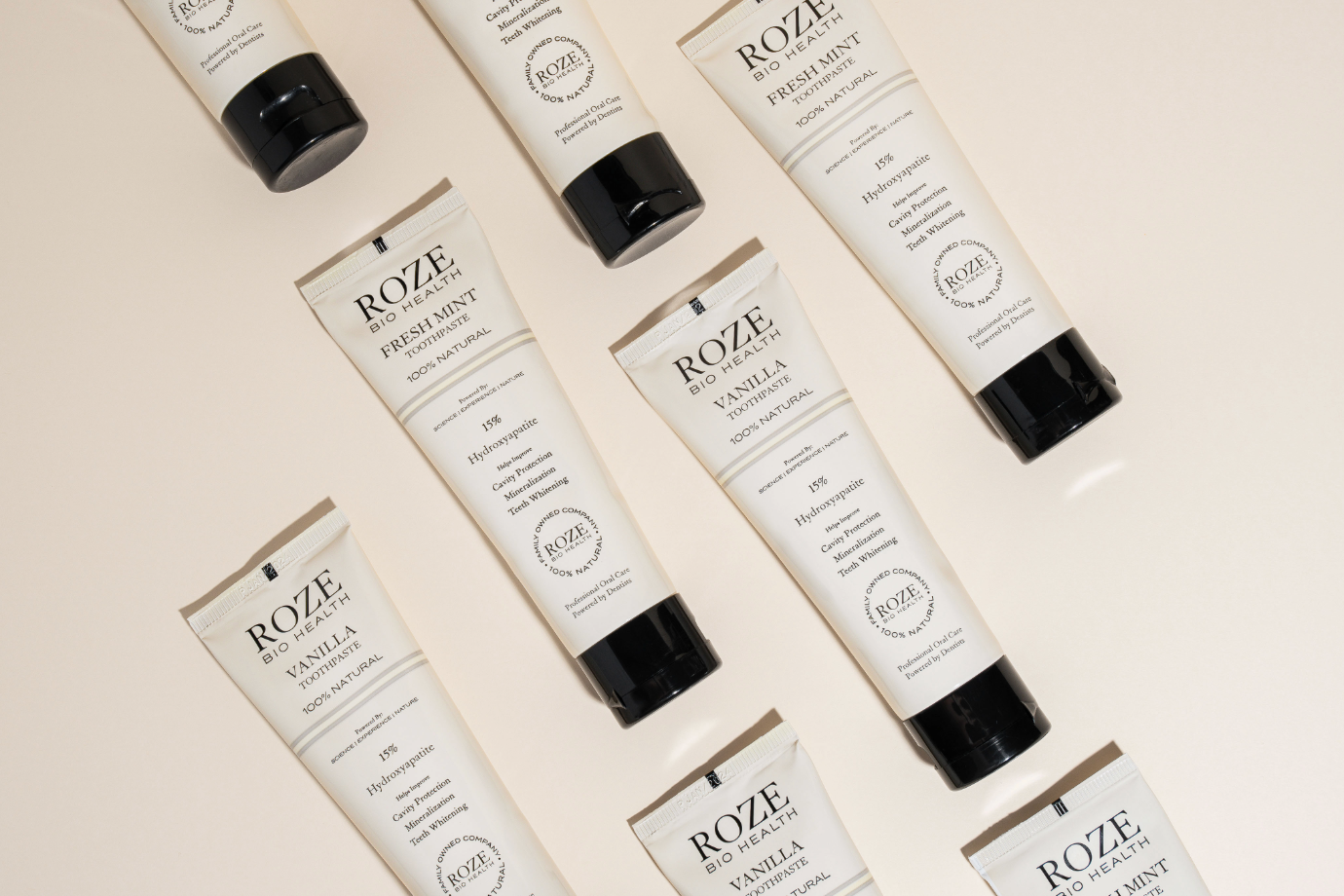
ROZE’s Natural Fresh Mint Toothpaste was formulated around that exact philosophy, combining 15% micro-hydroxyapatite with a carefully selected, fluoride-free formulation that supports healthy teeth using ingredients inspired by the body’s own biology.
Frequently asked questions
Is fluoride-free toothpaste effective against cavities?
A well-formulated hydroxyapatite toothpaste, used consistently as part of a full oral care routine, can help support cavity prevention for most people. As with any toothpaste, results depend on technique, frequency, and diet, and anyone with a high cavity risk should discuss their routine with a dentist.
Can hydroxyapatite actually rebuild enamel?
Hydroxyapatite can help support the remineralisation of weakened enamel by supplying the same mineral enamel is naturally made of. It works gradually with consistent use rather than instantly, and it cannot restore enamel that has already been structurally lost to decay.
Is hydroxyapatite toothpaste safe for daily use by adults and children?
Yes. It is food-grade and widely considered suitable for all ages, including during pregnancy, which is part of why many parents choose it for the whole family rather than buying separate formulas.
How long does it take to notice a difference after switching?
Many people notice reduced sensitivity or a smoother feel to their teeth within a few weeks of consistent use, though remineralisation is a gradual process and results vary by individual.
The takeaway
Fluoride-free toothpaste is not a compromise or a trend that skipped the science. It reflects a genuine, well-established alternative built around the mineral teeth are already made of. For anyone curious about making the switch, ROZE’s dentist-formulated range offers one place to start, though the myths above are worth setting aside regardless of which toothpaste ends up in your bathroom.