

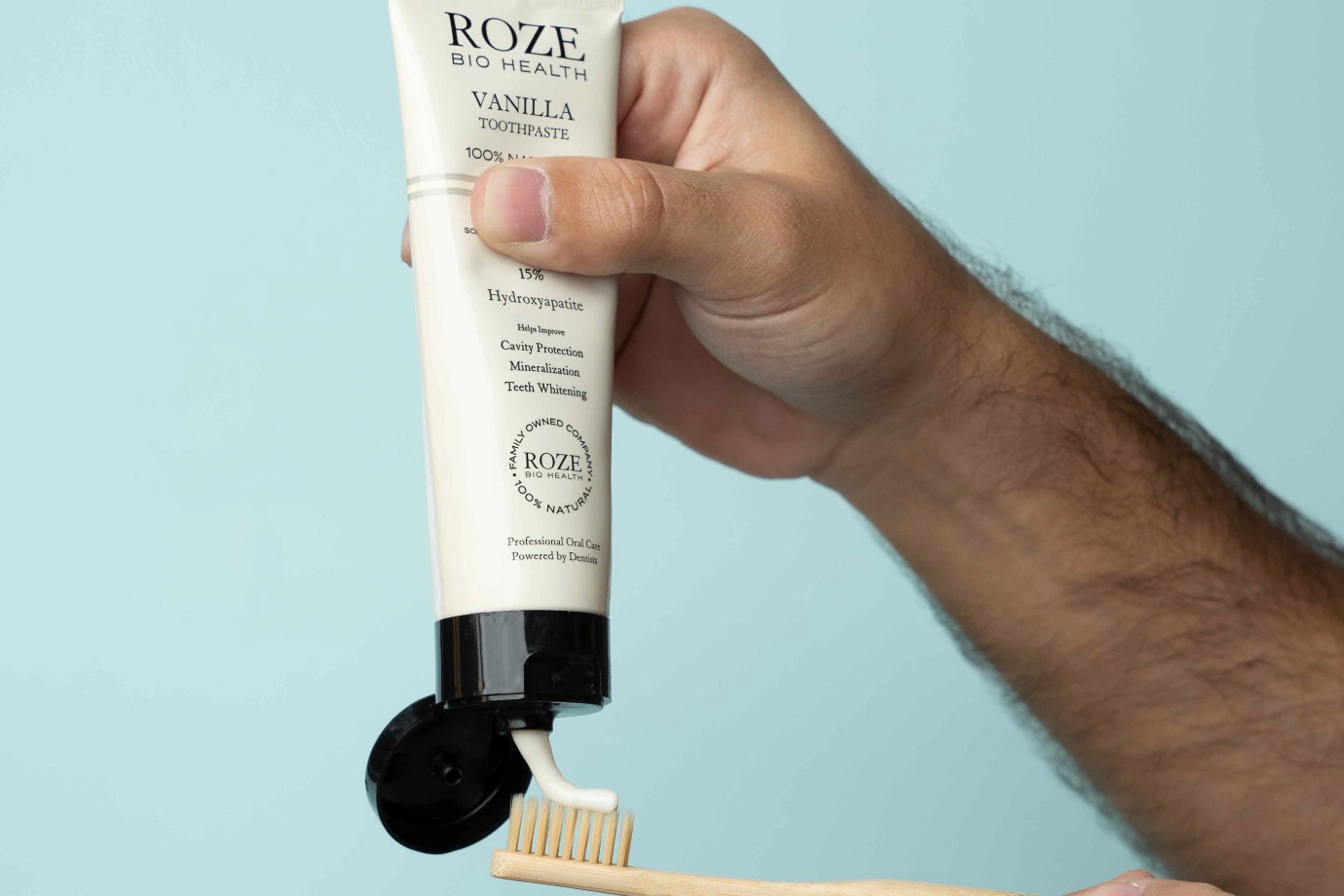
Stand in front of a supermarket toothpaste aisle for more than thirty seconds and the choice starts to feel strangely difficult. Whitening, sensitive, herbal, charcoal, kids’ bubblegum, each box promising something slightly different, and precious little on the front of any of them that actually explains what you are putting in your mouth twice a day.
Dr. David Roze, a biological dentist with more than thirteen years of clinical practice in Dubai, sees the confusion play out in his own patients regularly. His advice, distilled from years of chairside conversations, is to stop reading the marketing claims on the front of the box and start reading the ingredient list on the back. That single shift in habit is the foundation of a genuinely science-based approach to choosing the Best Natural Toothpaste for your own mouth.
Start with what you actually need it to do
Before considering ingredients, it helps to be honest about your own priorities. Someone managing sensitivity has different requirements from someone mainly concerned with whitening, and a parent buying for a five year old has different requirements again. A toothpaste is not one size fits all, however the marketing is presented, so identifying your own priority narrows the field considerably before you even look at a label.
- Sensitivity to hot, cold or sweet foods
- General cavity prevention and everyday maintenance
- Surface staining or a desire for a visibly brighter smile
- A gentle, food-grade formula suitable for young children
- A preference for avoiding synthetic additives altogether
Read the active ingredient first
Every toothpaste is built around one core active ingredient, and this is the single most important line on the label. For most of the last century that ingredient has been fluoride, a synthetic additive that forms a protective layer on the surface of the tooth. In recent decades, a Remineralizing Toothpaste built around hydroxyapatite has emerged as a widely used alternative, particularly in Japan where it has been the standard for more than forty years.
The distinction matters because the two ingredients work in different ways. Fluoride sits on top of the tooth, forming a surface layer, and a trace of it is swallowed with every brush no matter how carefully you rinse. Hydroxyapatite is the same food-grade mineral that already makes up roughly ninety seven percent of natural enamel, so it works by rebuilding the tooth’s own mineral structure from within rather than coating it with something synthetic. For a health-conscious reader asking why swallow what you do not have to, that difference is usually the deciding factor.
| What to consider | Hydroxyapatite | Fluoride |
|---|---|---|
| Type of ingredient | A food-grade mineral, naturally present in enamel | A synthetic additive |
| How it protects teeth | Rebuilds the mineral structure of enamel from within | Forms a protective layer on the tooth surface |
| Common companions on the label | Typically paired with gentler, naturally derived ingredients | Often paired with SLS, synthetic sweeteners and strong flavourings |
| Suitability for children | Widely considered appropriate given its food-grade nature | Requires careful dosing and supervision around swallowing |
Watch for what else is on the list
The active ingredient is only part of the picture. Many conventional toothpastes also contain synthetic additives that may offer little real benefit to your oral health and can be harsh or unnecessary for everyday use.
- Sodium lauryl sulfate (SLS): a synthetic foaming agent that can be drying and irritating for some mouths. Why add a harsh foaming agent when it isn’t needed to clean your teeth?
- Artificial colours and synthetic sweeteners: added mainly to improve appearance or taste, rather than provide meaningful oral-health benefits.
- Parabens: synthetic preservatives used in some formulations and increasingly avoided by people looking to reduce unnecessary chemical additives in their daily-care products.
- Microplastic particles: used in some products for polishing or texture, but unnecessary in a toothpaste that can ultimately be rinsed into the environment.
Don’t let “natural” on the label do all the talking. A toothpaste can be marketed as natural while still containing synthetic foaming agents, sweeteners, colours or preservatives. If you’re looking for a genuinely natural toothpaste, look beyond the marketing claims and check the full ingredient list.
Matching a toothpaste to your life stage
Once the ingredient question is settled, the second consideration is fit. A Toothpaste for kids should be gentle, food-grade and pleasant enough that a reluctant child will actually agree to use it, which is part of why ROZE developed its Watermelon Toothpaste specifically with families in mind. Adults managing sensitivity generally benefit most from a Sensitive Toothpaste built around a meaningful concentration of hydroxyapatite rather than one relying on numbing agents alone.
For anyone starting from scratch, ROZE’s bestselling Natural Fresh Mint Toothpaste is formulated with fifteen percent micro-hydroxyapatite, among the highest concentrations available in a consumer toothpaste, and is free from fluoride, SLS, parabens and artificial colours. A UAE Toothpaste made regionally, with certifications such as EU Certified and Halal status, also appeals to residents who prefer supporting a brand formulated with local conditions in mind.
A short checklist before you buy
- Identify your own priority: sensitivity, whitening, everyday care or a child-friendly option
- Check the concentration of the active ingredient, not just whether it is present
- Scan for SLS, parabens, artificial colours and microplastics, and avoid formulas that include them
- Consider whether a Dentist Toothpaste designed by a practising clinician suits your preference for expert formulation
- Favour a brand that explains its ingredient choices clearly, rather than relying on vague wellness language
Frequently asked questions
Is a natural toothpaste as effective as a conventional one?
A well-formulated natural toothpaste built around a meaningful concentration of hydroxyapatite is widely considered an effective everyday option for most adults and children. Anyone with a specific high-risk dental condition should discuss their individual needs with their dentist.
What makes a toothpaste genuinely fluoride-free rather than just marketed that way?
A genuinely Fluoride-free Toothpaste contains no fluoride compound anywhere on its ingredient list, such as sodium fluoride or stannous fluoride, and relies instead on an alternative active ingredient such as hydroxyapatite to support remineralisation.
How long does it take to notice a difference after switching?
Many people notice reduced sensitivity within a few weeks of consistent use, though results vary depending on individual circumstances and the severity of any underlying enamel wear.
Is it worth paying more for a premium formula?
Concentration and formulation quality genuinely matter for how effectively an active ingredient can work, so a higher-quality formula is often a reasonable investment, though the most important factor remains choosing one suited to your specific needs.
The bottom line
Choosing a toothpaste well simply means reading past the marketing and understanding what the label is actually telling you. Once you know what to look for, the decision becomes considerably less overwhelming. It is also worth remembering that no single toothpaste suits every household, so it is entirely reasonable to keep a different formula for a sensitive adult than for a young child, rather than assuming one tube has to serve everyone. For readers wanting a fluoride-free formula developed by a practising dentist as a starting point, ROZE’s range is one place worth exploring.